

Margin excess is the equity in a margin account above the maintenance requirement of the positions already held, and brokers use that figure — not the account balance — to decide whether your next order is accepted or rejected. The number most traders read instead is the platform's "buying power" field, a derived figure that refreshes on a schedule they have never checked. Margin excess explained for day traders starts with one uncomfortable fact: on a stock account, the base that governs your intraday size was frozen at yesterday's close, and nothing you make this morning changes it.
Three numbers, and traders read the wrong one
Open any equity platform and you get cash balance, buying power, and excess equity. They are not versions of the same thing. Cash tells you what settled. Excess equity tells you what is unencumbered right now. Buying power is a multiplier applied to excess under FINRA Rule 4210, and for a pattern day trader that multiplier is 4x — applied to maintenance excess as of the previous close.
That lag is where accounts break. A trader up $4,200 by 10:15 sees the platform's equity line climb and sizes the next trade as if the collateral grew with it. It did not. The FINRA margin rule anchors day trading buying power to the prior day's figure precisely so intraday marks cannot inflate leverage. Exceed it and you get a day-trade call, not a warning.
Futures traders have a different lag. The $500 day margin your broker quotes per ES contract exists only during a window. Somewhere between 15 and 30 minutes before the close, the requirement steps up to the exchange initial rate, which in 2026 sits near $20,000 per contract after several CME performance bond revisions. Your open trade did not change. Your available margin fell by 97%.
Margin excess explained for day traders as a risk denominator
Stop treating excess as a permission slip and start treating it as the denominator in your sizing math. Risk per trade is set by your stop and your account, but the number of concurrent positions you can carry at that risk is set by excess. Those two constraints collide, and when they do, one of them gives way. In most logs, it is the stop.
The buying power calculation is simple enough that you should do it by hand before the open. Take maintenance excess from the prior close. Multiply by four. That is your ceiling on the total maintenance requirement you can generate through day trades, and it is fixed until tomorrow. Then subtract, per open position, what the requirement becomes after the day margin cutoff. What remains is what you can actually deploy without either a call or a forced exit.
The pre-size review, in order
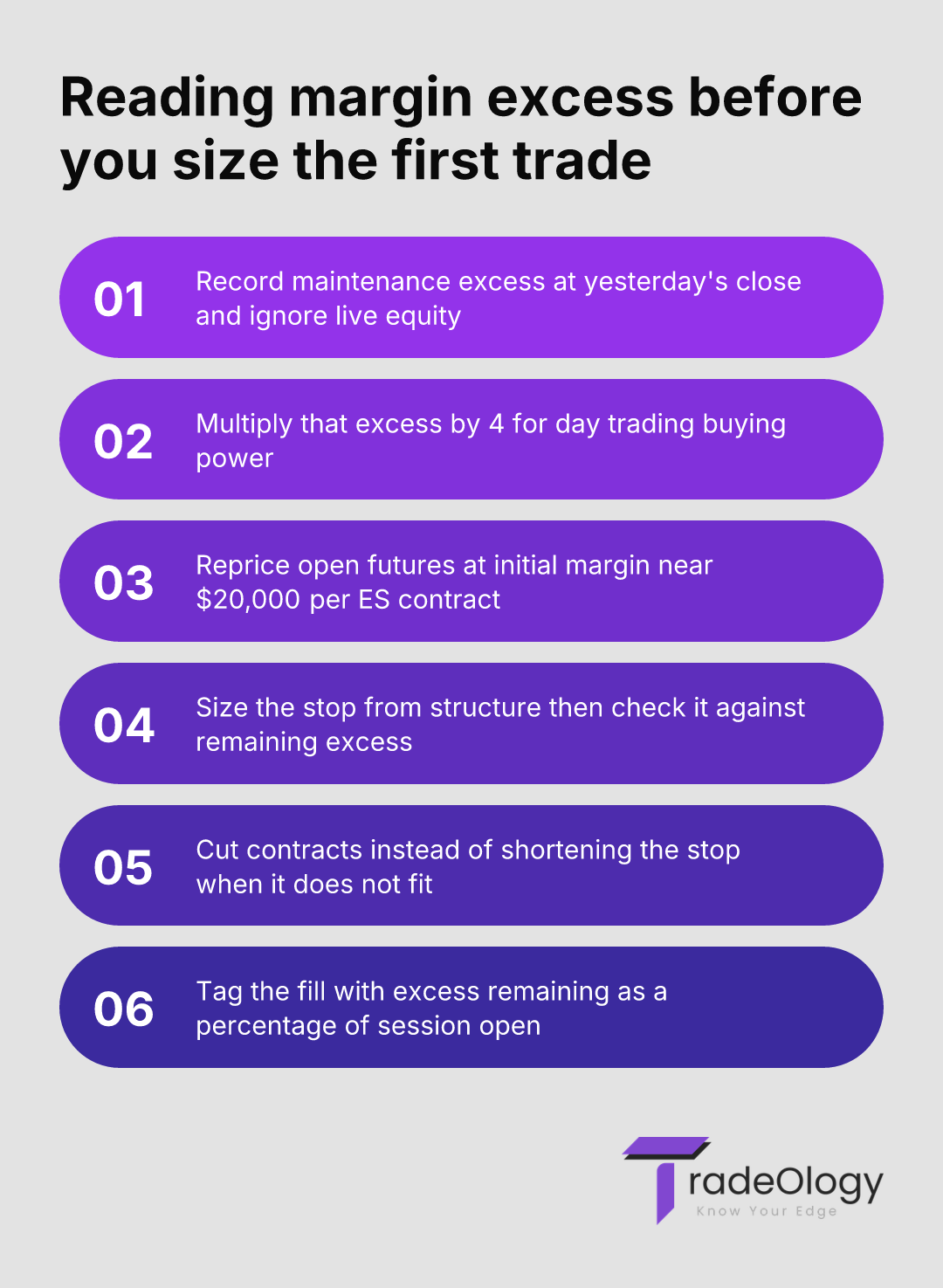
Record maintenance excess at yesterday's close. Not equity, not cash, not the headline buying power field.
Multiply it by four for day trading buying power, and by two for anything you intend to hold overnight under Reg T.
Price every open futures position at its overnight initial rate, not its day rate. If the account cannot fund that, you have an exit deadline, not a position.
Size the stop from structure first. Convert to shares or contracts. Only then check the maintenance requirement against remaining excess.
If it does not fit, reduce contracts. Never shorten the stop to make the fit work.
Tag the entry with excess remaining as a percentage of session-open excess.
Calculate prior-close maintenance excess by hand each morning and log it as a fixed number.
Tag every fill with remaining available margin as a percentage bucket: above 70%, 25% to 70%, under 25%.
Compare expectancy and average loss across those three buckets after 60 trades.
Eliminate any entry that required a stop tighter than the chart justified.
Review trade four and trade five of the session separately from trade one.
Metric | What it actually means | Action to take |
|---|---|---|
Maintenance excess at prior close | The only base your 4x day trading buying power is calculated from | Record it pre-open and treat live intraday equity as noise |
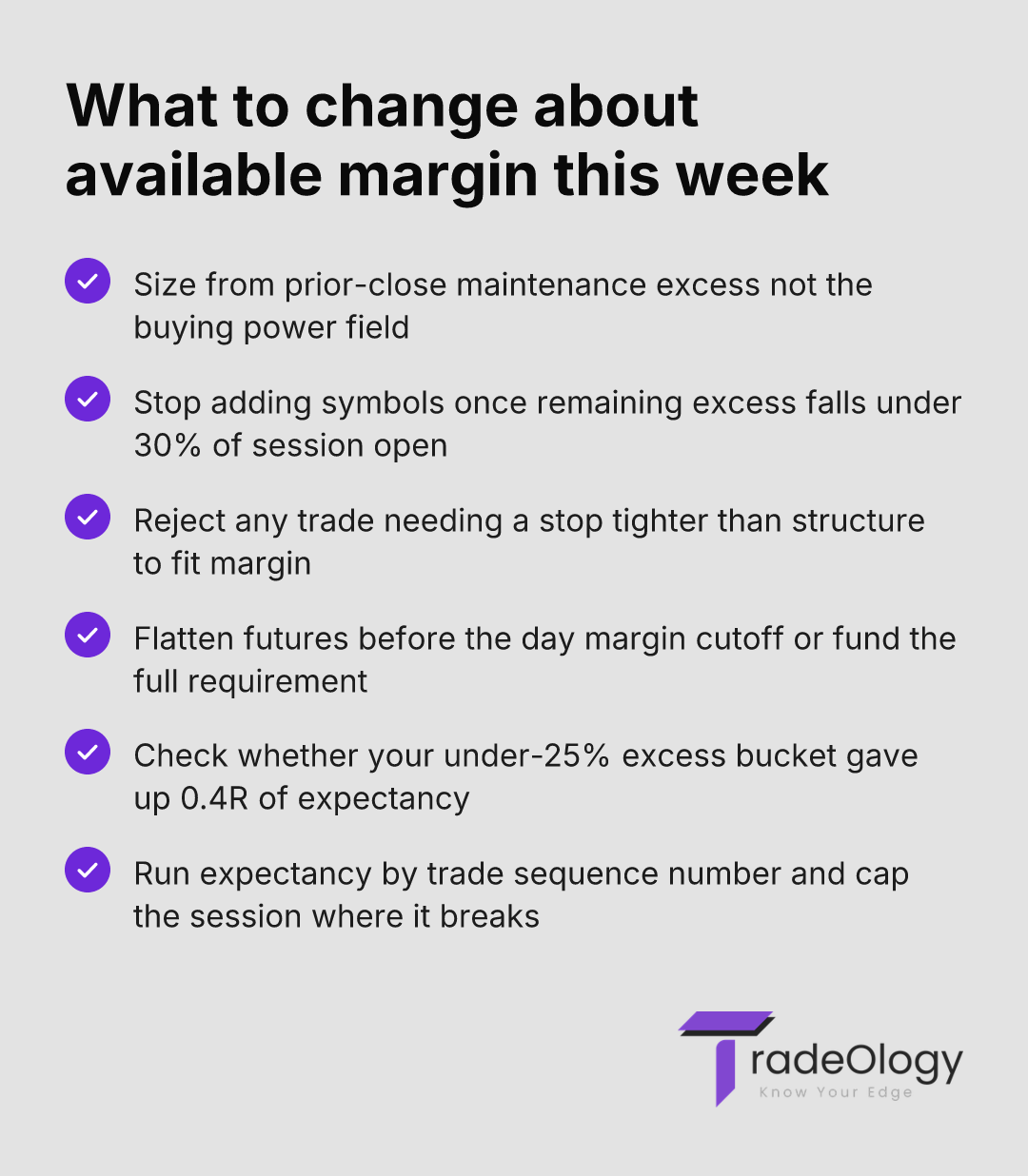
Available margin under 30% of session open | Four positions are competing for the same collateral | Add no new symbols until one closes |
Excess-constrained tag on more than 20% of fills | The broker is setting your risk per trade, not your stop | Halve base size so structure sets the stop again |
Day margin to initial margin gap above 10x | Holding past the cutoff costs 10x more collateral | Flatten before the cutoff or pre-fund the initial requirement |
Profit factor of trades 4+ below 1.2 | Later entries are being taken on depleted excess | Cap sessions at the trade count where profit factor breaks down |
The bucket almost nobody runs
Split your fills by excess remaining at entry and the result is consistent enough to test on your own log. Across tagged stock and futures logs I have reviewed, the same setup tag taken with over 70% of session-open excess produced roughly 0.35R to 0.45R more per trade than the identical tag taken under 25%. Win rate barely moved — two or three points. The average loss grew 20% to 30%.
The mechanism is not psychological. When excess is thin, the stop gets moved to fit the collateral. A trade that needed 14 ticks of room gets nine, and ordinary noise takes it out. Same setup, same session, worse R distribution — the loss side widened while the win side stayed put.
This is falsifiable, so falsify it. If your average loss in the under-25% bucket sits within 5% of your full-excess bucket, my explanation is wrong for your account and you have a selection problem, not a sizing problem. Look at the histogram bar for trades three through five and see which side of the distribution moved.
If more than one in five of your entries needed a stop tighter than the chart justified to fit inside available margin, your broker is setting your risk per trade, and your expectancy will keep reading as a setup problem forever.
What it cost one $65,000 account
Prior close: equity $65,000, 400 shares of a $60 stock held overnight, house maintenance 30%. Requirement $7,200, maintenance excess $57,800. Day trading buying power: $231,200.
Risk per trade at 1% is $650. First trade, 866 shares at $150 with a $0.75 stop, $130,000 notional. Second trade, $100,000 notional. Combined, he is at 99.5% of his ceiling. Then a third setup fires, the platform's equity line shows a $2,400 unrealized gain, and he takes it at full size.
The broker issued a day-trade call for the deficiency — about $15,000 here, since the third position's maintenance requirement outran remaining excess. He exited the second trade at +$310 to clear it, abandoning a move that finished at +$1,300. Then came the restriction: five business days at cash-available buying power. Three of his 1.9R average setups triggered during that stretch and went untraded. Cost of the restriction alone, at normal size, was roughly $3,700 — more than 5% of the account, from a sizing decision made off the wrong field.
Mistakes that produce calls
Sizing off the buying power field. It is a 4x output of a stale input. Read the input.
Counting unrealized intraday gains as collateral. They do not raise day trading buying power until settlement.
Holding futures through the day margin cutoff without funding initial margin. A 40x requirement jump forces the exit, and the market chooses the price.
Selling naked options against notional buying power. The requirement moves with volatility, not with your entry price.
Ignoring the overnight step-down. Anything carried past the close is a 2x account, not a 4x one — the same mistake that shows up in swing trading risk management when traders size for the stop instead of the gap.
Where the log does the work
None of this survives memory. You need the excess bucket attached to the fill at the time of the fill, which means the tag goes on during your review process, not at month end. TradeOlogy rebuilds executions into round trips across stocks, options, futures, and crypto, so you can filter expectancy, profit factor, and average loss by your own custom tags — including an excess-remaining tag — and by session and hour.
Two views matter here. First, expectancy by trade sequence number: if trade one runs at 0.6R and trades four and five run negative, excess depletion is the likely driver. Second, average loss by excess bucket, which exposes stops that were shortened to fit collateral. If your fills are arriving from a spreadsheet, confirm they arrived intact first — CSV imports drop round trips routinely, and a missing leg destroys the bucket comparison. The fill-level test is worth running before you trust any of it. Free trial, cancel anytime.
FAQ
Does an intraday profit raise my margin excess before the close?
Excess equity rises with unrealized gains, but day trading buying power does not. That figure is fixed at four times the prior close's maintenance excess for the whole session. Trading against an inflated equity display is the fastest route to a day-trade call.
How do I calculate day trading buying power from maintenance excess?
Take maintenance excess at yesterday's close and multiply by four. That result caps the total maintenance requirement your day trades can create, not the notional you can touch. For positions carried overnight, the multiplier drops to two under Reg T.
Why does my futures margin jump minutes before the close?
Brokers offer discounted day margin only inside a defined window, then revert to the exchange initial requirement. On an ES contract that can mean moving from about $500 to roughly $20,000. Flatten before the cutoff or fund the full requirement in advance.
What does a day-trade call do to my sizing?
The account drops to cash-available buying power for five business days, which typically cuts effective size by 75%. Fail to meet the call and the restriction extends to 90 days of cash-only trading. The real cost is the setups you cannot take.
Do options and crypto consume margin excess the same way?
No. Defined-risk option spreads hold requirement equal to max loss, while naked short options carry a requirement that expands with implied volatility. Crypto margin varies by venue and is often unavailable, so treat crypto size as cash-funded unless your broker states otherwise.
The standard to hold
Print prior-close maintenance excess, multiply by four, and write that number where you can see it before the first order. Then tag every fill with what was left. Two weeks of that data will tell you whether your worst trades are bad setups or trades taken on depleted collateral — and a filtered review will settle it faster than another month of guessing.
Verdict: Margin excess explained for day traders comes down to one correction — size from prior-close maintenance excess, never from the buying power field the platform refreshes in front of you. The trades you take on thin excess are the same setups with a worse stop, and they cost roughly 0.4R each.