

Your Dashboard is Green, But Your Strategy is Broken
You closed the week up 2%. You check your P&L, see the green number, and close your laptop. You call that a review. It is not. It is self-deception. It’s the reason you make the same expensive mistakes every quarter.
Your real performance isn’t in that top-line number. It’s buried in the trades you ignore: the small losses that violated your rules, the winning trades you mismanaged and left money on the table, and the setups you took out of boredom. You think a positive week means your process is working. It often means you got lucky.
This is not a guide on learning how to review your trades. You are already doing that. This is a guide on how to stop lying to yourself when you do it.
You Think You Are Reviewing. You Are Actually Hunting for Confirmation.
Here is where the damage starts. Your review process is designed to make you feel good. You scroll past the undisciplined trades to focus on the one or two big winners that followed your plan. You tell yourself, "I just need to do more of that."
This is a catastrophic error in thinking. It reinforces the idea that your good trades are skill and your bad trades are just "the cost of doing business." That cost is bleeding you dry. A proper review forces you to stare at your worst habits until they become patterns. And patterns can be broken.
You are avoiding the data because it is telling you something you don’t want to hear: your discipline is inconsistent, your favorite setup is underperforming, or your risk management is a suggestion, not a rule. You must confront this. A trading journal isn't for record-keeping; it's an evidence locker for your bad habits.
What Actually Matters: Filters, Not Feelings
Stop looking at your trade history as a single list. It is a database. You need to query it. A productive review is a series of questions—filters—that expose the weak points in your system. Your feelings about a trade are irrelevant. The data is all that matters.
The goal is to isolate variables until you find the source of your P&L leaks. Here are the filters that matter:
Filter by Setup: Which specific patterns are profitable, and which are draining your account?
Filter by Time of Day/Week: Are you giving back all your Tuesday profits on Friday afternoon? The data will show you.
Filter by Holding Time: Are your quick scalp winners completely offset by one long, slow bleed on a swing trade gone wrong?
Filter by Deviation: Show me every trade where you violated your entry, stop, or profit-taking rules. How much did that cost you?
This isn’t about finding a "perfect" setup. It is about identifying and eliminating the behaviors that invalidate the setups you already have. Your edge is fragile. Unfiltered execution destroys it.
A Better Review Process: How to Review Your Trades From the Ground Up
This is not a casual five-minute task. This is a deliberate, structured analysis. Do it weekly. No exceptions.
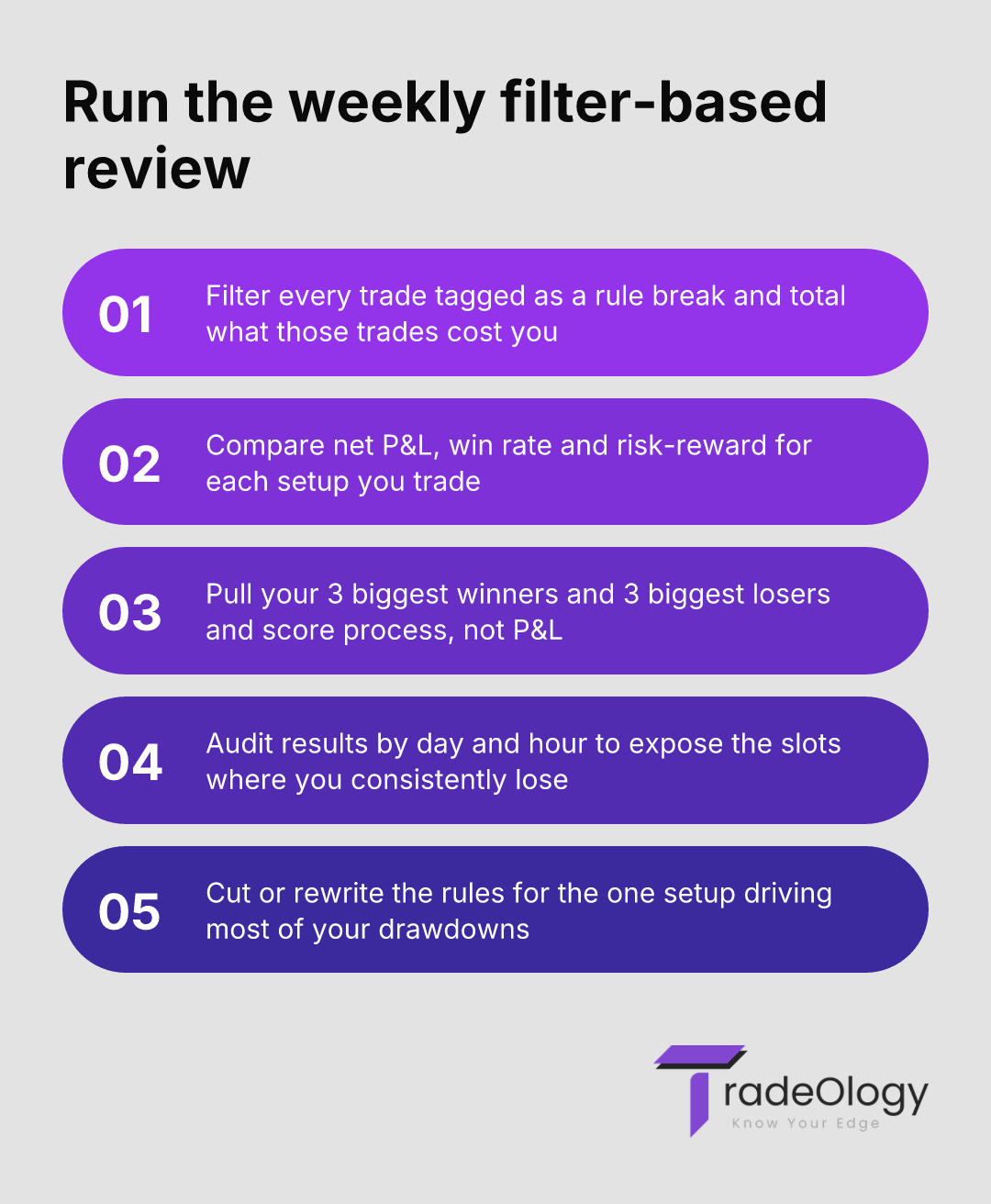
Isolate Your Rule Breaks. In your journal, you must tag trades where you broke your plan. Now, filter for them. What is the total P&L of just these trades? For most traders, this number is a shocking net loss that erases a significant chunk of their gains. This is the cost of your impatience.
Analyze Performance by Setup. You trade three setups: a breakout, a reversal, and a trend-pullback. The breakout feels exciting and active. The data from 2026 shows it’s consistently profitable during high volatility periods but is a slow bleed otherwise. Your review must show the expectancy of each setup. Filter your trades. What is the net P&L, win rate, and risk-reward for each? You will likely find one setup is responsible for the majority of your drawdowns. Stop taking it or fix the rules.
Review Your Outliers. Filter for your 3 biggest winning trades and 3 biggest losing trades this month. Forget the P&L. Did you follow your process? It is common to find the biggest winners involved breaking a rule (e.g., holding too long, adding to a winner without a plan) and the biggest losers involved the same. You are being rewarded for bad behavior and punished for it, creating outcome unpredictability. This is why your results are unstable. You need to calculate and understand your trading expectancy for each scenario.
Run a Time-Based Audit. Filter your results by day of the week and time of day. The data does not lie. If you consistently lose money between 2:00 PM and 4:00 PM ET as the market ranges, stop trading then. It’s that simple. Protecting capital is more important than forcing trades in a low-probability environment.
Real-World Example: The Slow Bleed You Don’t See
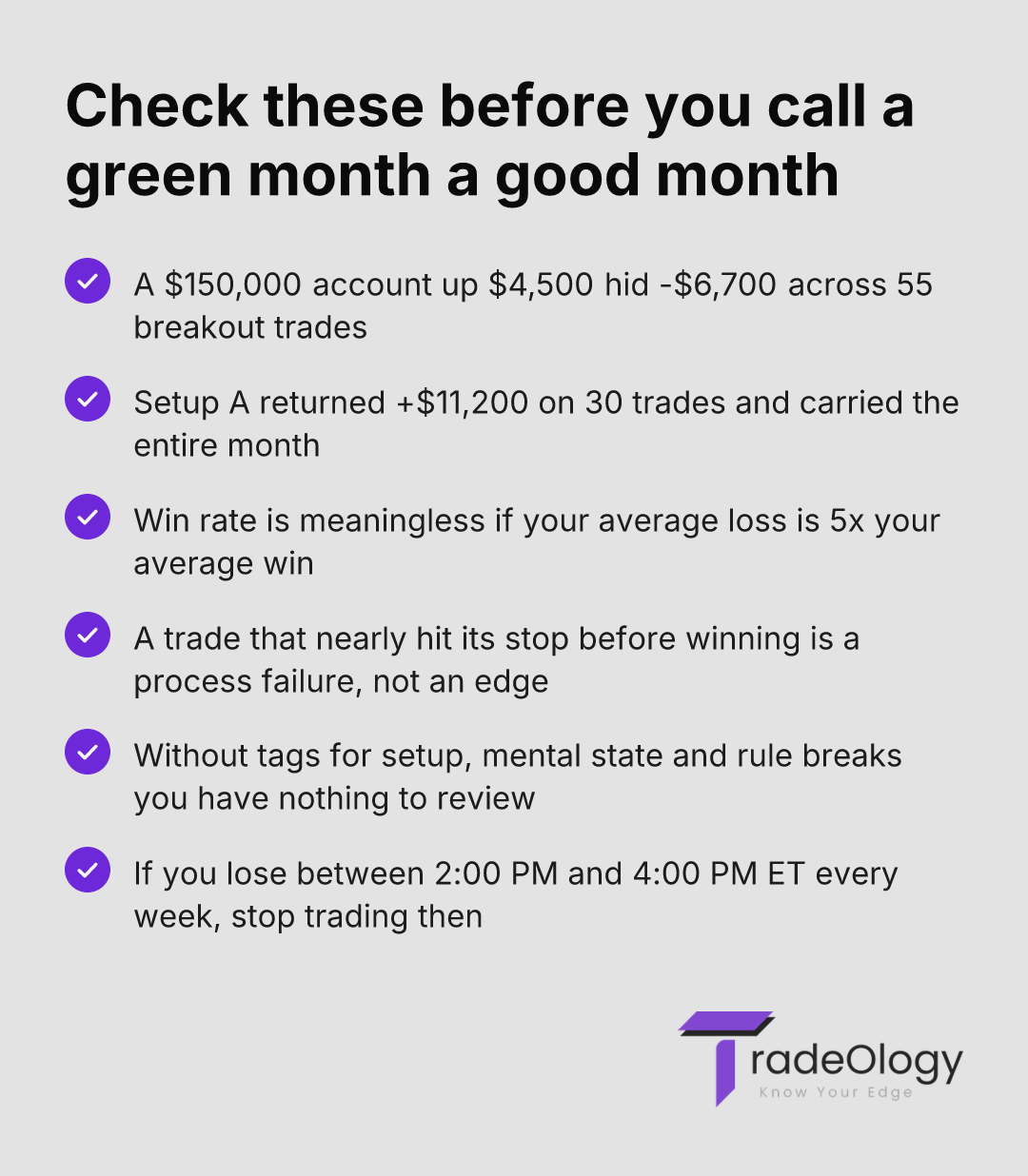
A trader with a $150,000 account finished the month up $4,500. A surface-level review shows success. But a deeper dive reveals a terminal problem.
Total Trades: 85
Setup A (Reversal): +$11,200 on 30 trades.
Setup B (Breakout): -$6,700 on 55 trades.
The trader feels like the breakout strategy is more active and offers more opportunities, so they take it more often. The data proves it is a P&L leak. The "successful" month was entirely dependent on one setup outperforming enough to cover the consistent losses from another. The problem is clear: Setup B is either a bad strategy or it is being executed badly. Without this review, the trader would continue bleeding from Setup B, waiting for a month when Setup A doesn’t perform well enough to cover the losses, leading to a massive drawdown.
This is what a real review finds. It points to the specific, high-leverage problem that needs to be fixed. The solution isn’t to "trade better." The solution is to analyze the performance of the breakout setup, identify why it’s failing, and either fix it with stricter rules or eliminate it entirely.
Common Mistakes You Are Still Making
Focusing on Win Rate: A high win rate is useless if your average loss is 5x your average win. You are picking up pennies in front of a steamroller. The only metric that matters is expectancy.
Ignoring near misses: A trade that almost hit its stop loss before turning into a winner wasn’t a good trade. It was a lucky one. Your review must flag these as process failures.
Blaming the Market: "The market was choppy" is not an analysis. It’s an excuse. Why were you trading in a choppy market if your strategy requires clear trends? The failure is in your decision to engage, not in the market’s behavior.
Reviewing Without Data Tags: If you aren't tagging trades with the setup, your mental state, and rule deviations, you have nothing to review. You just have a list of trades. This is the foundational failure of most traders. Start here. You can learn more about this in our article on fixing your trade review process.
How TradeOlogy Removes the Excuses
The process described above is not easy. It is tedious if done manually in a spreadsheet. This friction is why most traders fall back to surface-level reviews.
TradeOlogy is built to solve this friction. It is not a magic solution. It is a tool for professional discipline.
Instead of spending hours exporting and sorting in Excel, you import your trades and the analysis is automated. TradeOlogy allows you to apply the exact filters that expose weakness:
Automatic Tagging and Filtering: Instantly see the P&L, expectancy, and performance metrics for every tagged setup, mistake, or custom rule. The analysis from the $150,000 account example above takes seconds, not hours.
Time-Based Analysis: Click a button to see your performance by hour of the day or day of the week. Expose the time slots where you are consistently unprofitable.
Advanced Analytics: Metrics like MFE/MAE are calculated for you, showing exactly how much money you leave on the table or how much adverse excursion you tolerate before a trade turns profitable.
The platform doesn’t make the decisions. It presents the unvarnished truth so your decisions become ruthlessly efficient. It removes the ability to hide from your own data.
FAQ
How often should I do this deep review?
A high-level review of all trades should happen daily, taking no more than 15 minutes to tag and comment. The deep, filter-based review described here must be done weekly. Anything less and you are allowing bad habits to compound.
What if all my trades are discretionary?
Then you have a bigger problem than your review process. "Discretionary" cannot mean "without rules." Even a discretionary trader has a framework. You must define that framework and review against it. If you cannot, you are gambling, not trading.
Is it possible to over-analyze?
Yes, if analysis leads to inaction ("paralysis by analysis"). The goal is not to find perfect data. The goal is to find the 1-2 biggest leaks in your process and fix them. Identify the problem, implement a change, and measure the result. Don't get stuck in the data.
The Standard Is the Standard
Your results will not improve until your review process does. The market does not care about your intentions. It rewards disciplined execution and punishes impulsive, unstructured behavior. A vague review process enables that destructive behavior.
Stop looking for confirmation and start looking for your blind spots. The data contains everything you need to know. Learning how to review your trades with brutal honesty is the only path to building a durable, professional trading career. The rest is just noise.