

Your Real-Time P&L Is Lying to You
You think you are reviewing your trades because you keep your P&L open. You watch the number go green, you watch it go red. You feel the market. This is not a review. This is entertainment, and it is the fastest way to sabotage your execution. Your emotional state is tethered to a number that has no predictive value. The constant feedback loop of floating profit and loss pushes you into emotional decisions—closing winners too early, holding losers too long. It is the illusion of control.
The search for the best time to review your trades is not about finding a magic window during the trading day. It is about building a professional process that separates execution from evaluation. That process happens when the market cannot influence your judgment. Anything else is just you gambling on your feelings.
That Is Not the Real Problem. This Is.
The real problem is your review process is unstructured and emotional. You look at your losers with regret and your winners with relief. You treat review as a form of self-punishment or ego-stroking. The goal is not to feel bad about losses or good about wins. The goal is to extract data. Your feelings are irrelevant to this process.
An effective review has layers. It is not a single event. It is a system. Each layer serves a different purpose, from immediate data capture to long-term strategic adjustments. Without this structure, you are just looking at charts and hoping for an epiphany. That is not a strategy for a career; it is a recipe for burnout.
A Review System That Actually Works
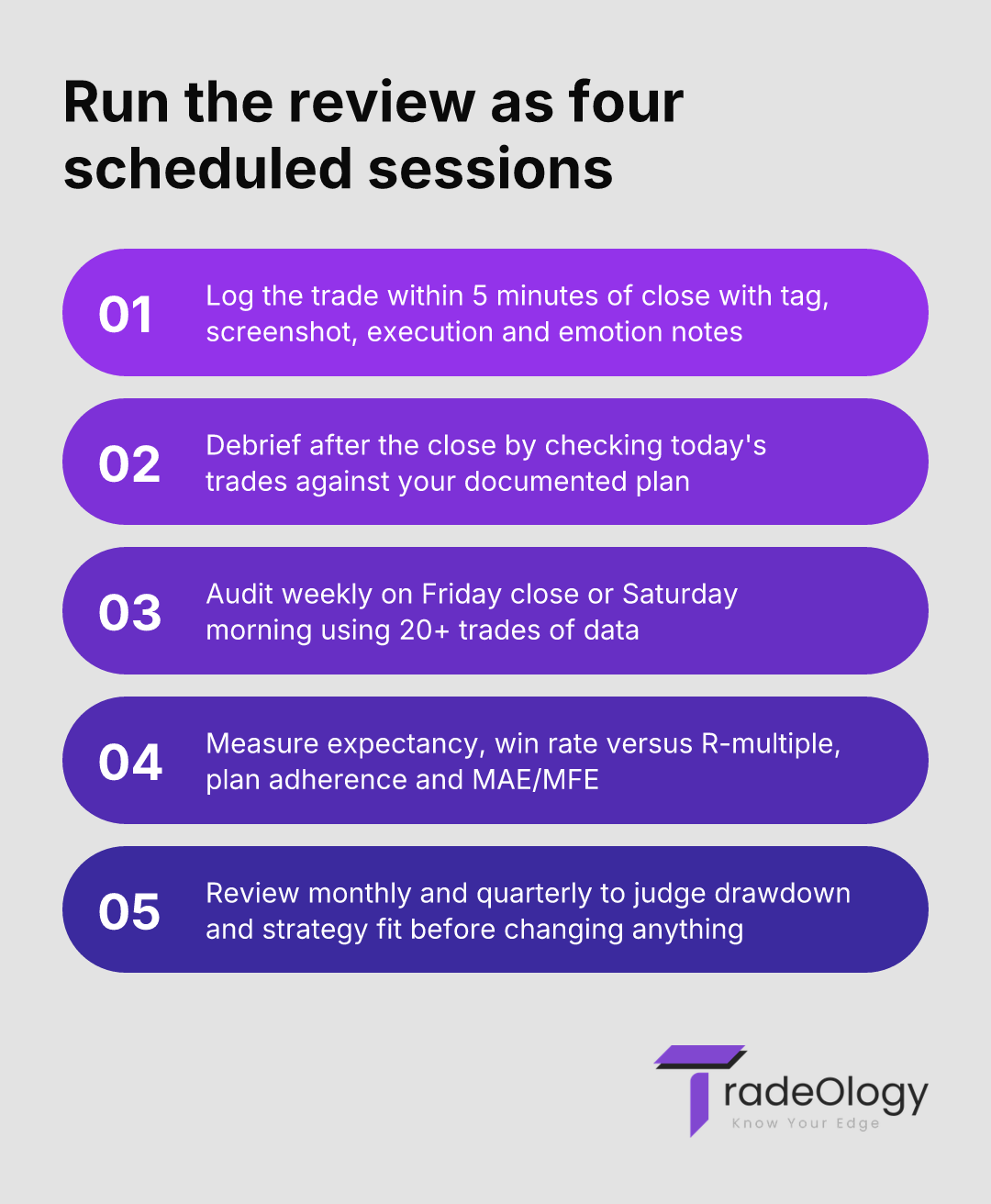
Stop looking for one perfect moment. A professional review is not one event, but four distinct, scheduled sessions. Each one has a specific job. Each one happens when you are not in a position to be influenced by live market action.
1. The Immediate Post-Trade Triage (Within 5 Minutes of Close)
This is not an analysis. It is data entry. The moment a trade is closed—win, loss, or scratch—your job is to capture the "why" before your memory corrupts the narrative. Your brain will immediately start rewriting history to make you feel better or worse than you should. You must capture the raw data before this happens.
Tag the setup. No exceptions.
Screenshot your entry, stop, and target on the chart. Not later. Now.
Write one sentence on your execution quality. "Held for the full target," "Moved stop prematurely," "Hesitated on entry."
Write one sentence on your emotional state. "Anxious," "Confident," "FOMO entry," "Revenge trading."
This takes two minutes. Do it immediately. This raw data is the foundation for any real analysis later. If you do not do this, any review you perform hours or days later is based on a lie. We have an entire article on why a trading journal is your most crucial tool for exactly this reason.
2. The End-of-Day Debrief (After Market Close)
This is your first real analysis session. The market is closed. The P&L for the day is final. Now you can look at the data without the urge to act. The goal here is to identify patterns from the day and check for process deviations.
Review today's trades against your plan. Did you trade your documented setups?
Check for unforced errors. Did you miss a planned trade? Did you chase an entry? Did you oversize or undersize your position? As we've said before, your P&L is a liar if it doesn't account for these mistakes.
Review your notes. Look at the emotional state sentences you wrote. Is there a pattern? Do you get anxious after two losses? Do you get greedy after a big win?
Prepare for tomorrow. What is the market context? Are there major news events? Clear your head. The day is done. Do not carry it into tomorrow.
3. The Weekly Performance Audit: The Best Time to Review Your Trades for Real
This is the most critical review session you will conduct. Friday close or Saturday morning is the ideal time. The distance from the live market provides the objectivity you need. This is where you ignore single-trade outcomes and analyze your system's performance metrics. Your weekly results tell you the truth.
Focus on these metrics:
Expectancy: Is your system mathematically profitable over the last 20+ trades? Use the data. Do not guess. A negative expectancy means you are on a guaranteed path to zero. Read our guide to calculating and improving trading expectancy if you are not doing this.
Win Rate vs. Risk-Reward: Are they in balance? A low win rate requires a high R-multiple per trade to be profitable. Are you achieving your target R-multiple on winners?
Adherence to Plan: What percentage of your trades this week were "Plan A" setups? How much did you lose on trades that were not? You are bleeding money here and your journal proves it. This is where you see the real cost of impulsive decisions.
MAE/MFE Analysis: Maximum Adverse Excursion tells you if your stops are too tight. Maximum Favorable Excursion tells you how much money you are leaving on the table. Analyzing this data, especially with advanced trading analytics, shows you exactly where your stop and target placement needs work.
4. The Monthly & Quarterly Strategic Review
This is where you look at the big picture. Are you in a drawdown? How does it compare to your historical drawdowns? Is your strategy still effective in current market conditions? This review, done at the end of each month or quarter, prevents you from making drastic changes based on short-term noise. For a deeper dive on this, read how to properly evaluate a trading strategy.
This is also the time to review your goals and personal development. Are you getting better at managing your emotions? Is your execution cleaner? The data will tell you.
A Practical Example: Why This Process Matters
A trader with a $50,000 account risks $500 per trade (1%). After a week, their P&L is +$1,200.
A surface-level review says: "Good week. I made money."
A professional review using the layered system shows something else:
Total Trades: 15
Planned Trades (A+ Setups): 8
Impulsive Trades (Not in Plan): 7
P&L from Planned Trades: +$3,500
P&L from Impulsive Trades: -$2,300
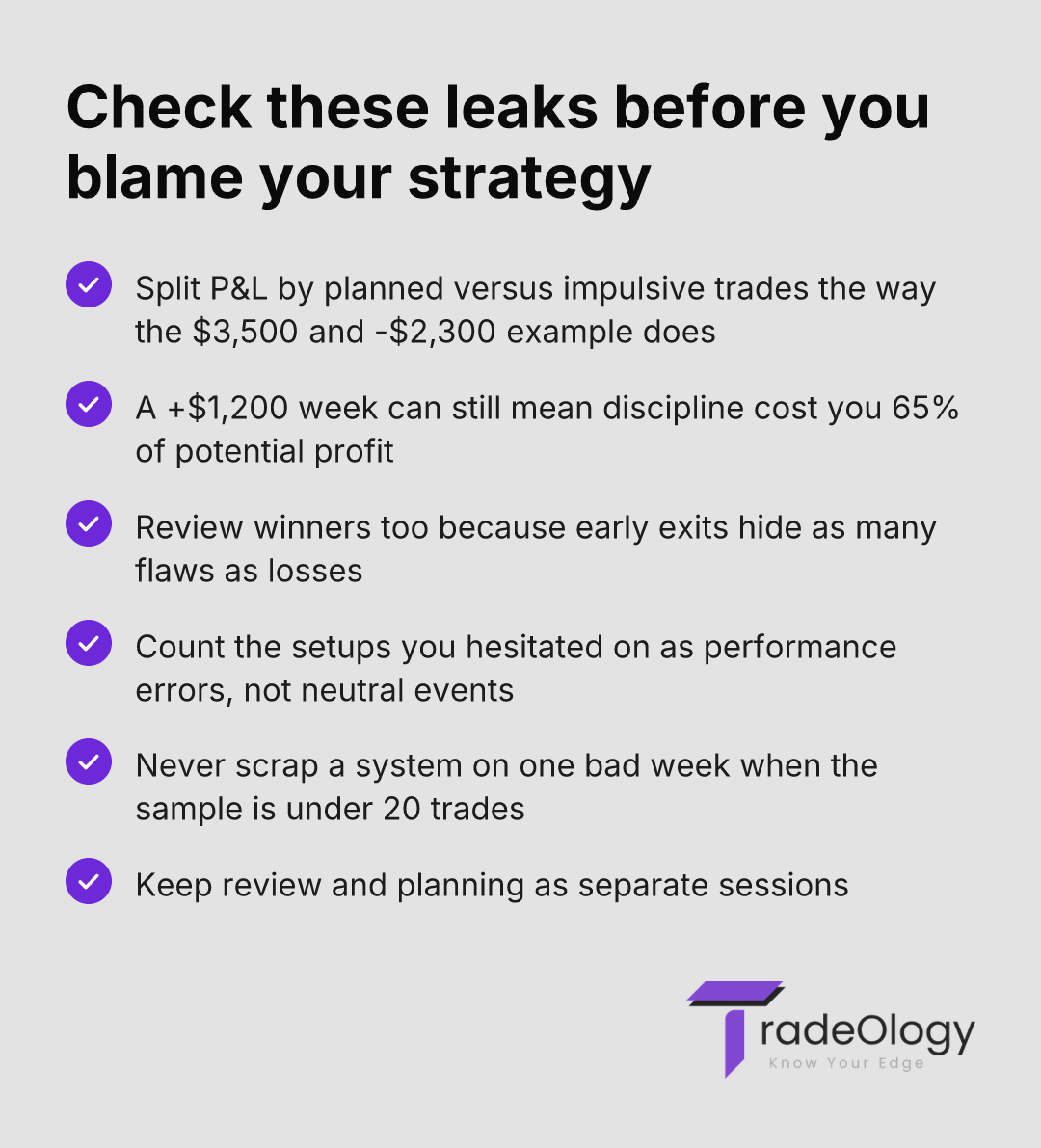
The conclusion is not "I had a good week." The conclusion is: "My core strategy is highly profitable, but my lack of discipline is costing me 65% of my potential profit." The problem is not the strategy. The problem is execution. He made $1,200, but his data shows he should have made $3,500. This is how you find the leaks in your process. This is why your results are unstable.
Common Mistakes Holding You Back
Reviewing only losses. This creates a negative feedback loop and ignores the data from your winning trades, which often reveals just as many flaws (e.g., exiting too early).
Ignoring non-executed trades. You hesitated on three perfect setups this week. Why? What was the common theme? This is a performance error just as costly as a losing trade.
Changing your strategy after a few losses. Your weekly and monthly reviews exist to prevent this. You must trust your edge over a large sample size. As a great resource, refer to the CME Group's page on developing a trading plan to understand the importance of sticking to a tested strategy.
Failing to separate review from planning. Your review session is to analyze past performance. Your planning session is to prepare for future opportunities. Do not mix them.
How TradeOlogy Forces Discipline Here
You can do all of this in a spreadsheet. But you will not. Not consistently. Your human tendency is to avoid this level of uncomfortable detail. This is where automation becomes a tool for discipline, not a crutch.
TradeOlogy does not have an opinion. It ingests your trade data and presents it back to you, stripped of emotion. The platform forces the structure:
Automated Tagging & Filtering: Did you want to know how much money your "FOMO" trades cost you last month? The dashboard will show you the exact number. You cannot hide from it.
Instant Expectancy Calculation: No need for manual formulas. You can filter by setup, by time of day, or by market condition and see your expectancy for each variable instantly.
MAE/MFE & P&L Analysis: The platform charts your MAE/MFE automatically. It shows you exactly where you could be optimizing stops and targets, removing the guesswork. It shows you the truth about what your habits, not your strategy, are doing to your P&L. For a stark look at how misleading P&L can be, read our breakdown on the profit factor.
A clean dashboard does not fix bad process. But it eliminates the excuses for not having a good one.
FAQ
What if I don't have time for all these review sessions?
Then you do not have time to be a profitable trader. The Marine Corps has a saying: "Slow is smooth, and smooth is fast." Rushing this process leads to repeated mistakes, which costs far more time and money than a structured review. The time spent here directly impacts your P&L.
Should I review trades on a live trading day?
No. The only thing you should do is the immediate post-trade triage to capture raw data. Any deeper analysis must wait until the market is closed. Reviewing performance while you still have open risk is a direct path to emotional errors. You will be tempted to "fix" your day, which is not a professional mindset.
My strategy seems to be failing. How long should I wait before changing it?
Your monthly and quarterly reviews are designed to answer this. First, your weekly review must confirm that you are executing the strategy with high discipline. If your data shows poor execution, the problem is not the strategy. If you have a month of high-discipline trading and the strategy is still producing a negative expectancy, then you investigate. Has the market regime changed? Has volatility changed? Do not scrap a strategy based on one bad week. Use the data over a significant sample size.
The Bottom Line Is Not Your P&L
Your P&L is an outcome. Your process is the engine. You are obsessed with the outcome, which is why your results are erratic. Shift your focus. Your job is not to make money on any single trade. Your job is to flawlessly execute a proven process. Profit is the byproduct.
Stop asking about the best time to review your trades as if it is a shortcut. The real answer is a disciplined, multi-layered system that you execute without fail. Your review process is your quality control. Without it, you are just producing defects and hoping one of them is a winner.