
Your Net P&L Is a Terrible Judge of Performance
A positive P&L can hide a spectacular amount of bad trading. A trader can end the month up $5,000 and still be on the verge of ruin. This happens all the time. One oversized, lucky win papers over the cracks of a dozen undisciplined, costly mistakes. The raw P&L figure feels good, but it lies. It tells you what you made, but it says nothing about how you made it or if that performance is repeatable.
Here is where traders fool themselves: they see a green number and assume their process works. They ignore that their account is bleeding from a thousand small cuts, plugged temporarily by one outlier. This is why their equity curve looks less like a steady climb and more like a cardiac monitor during a panic attack. The real path to durable profitability is not found in the final P&L number. It's found by analyzing the quality of your gains and losses. This requires a better metric: profit factor trading.
Profit factor exposes the truth. It’s a simple, brutal calculation: total money gained from winning trades divided by total money lost from losing trades. That’s it. It’s the engine of your P&L, and if the ratio is weak, your entire trading business is fragile.
The Brutal Honesty of Profit Factor Trading
Profit factor tells you how much you make for every dollar you lose. If you made $20,000 in winning trades and lost $10,000 in losing trades, your profit factor is 2.0. This is a healthy system. For every $1 you risked and lost, you made $2 back on your winners.
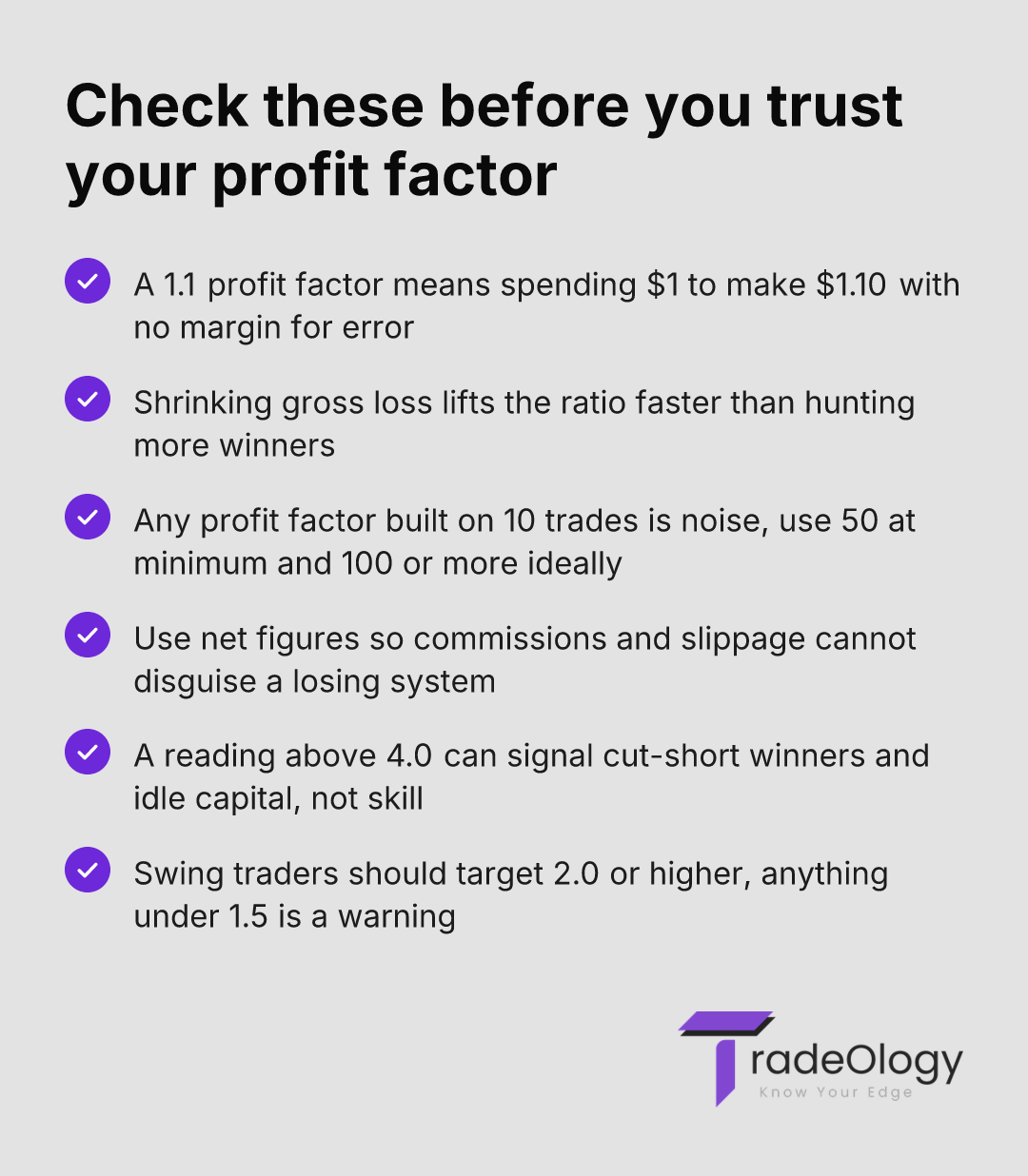
If you made $11,000 and lost $10,000, your profit factor is 1.1. This is a system on life support. You are one string of bad trades—or even just a return to statistical normalcy—away from a serious drawdown. You are spending $1 to make $1.10. The margin for error is non-existent, and commissions and slippage are eating you alive.
Most traders fixate on win rate. It’s a vanity metric. A 70% win rate is worthless if the 30% of losers wipe out all the small wins and then some. Profit factor synthesizes win rate and the magnitude of those wins and losses into a single, unforgiving number. Improving your trading is not about desperately finding more winners. It’s about systemically improving this ratio. In 2026, with an abundance of accessible data tools, trading without knowing this number is an act of self-sabotage.
Step 1: Isolate Your Strategy’s True Performers
Not all trades are created equal. Your trading journal should not be a simple log of entries and exits; it must be a database for analysis. The first step to improving your profit factor is to stop looking at it as one number. You must dissect it.
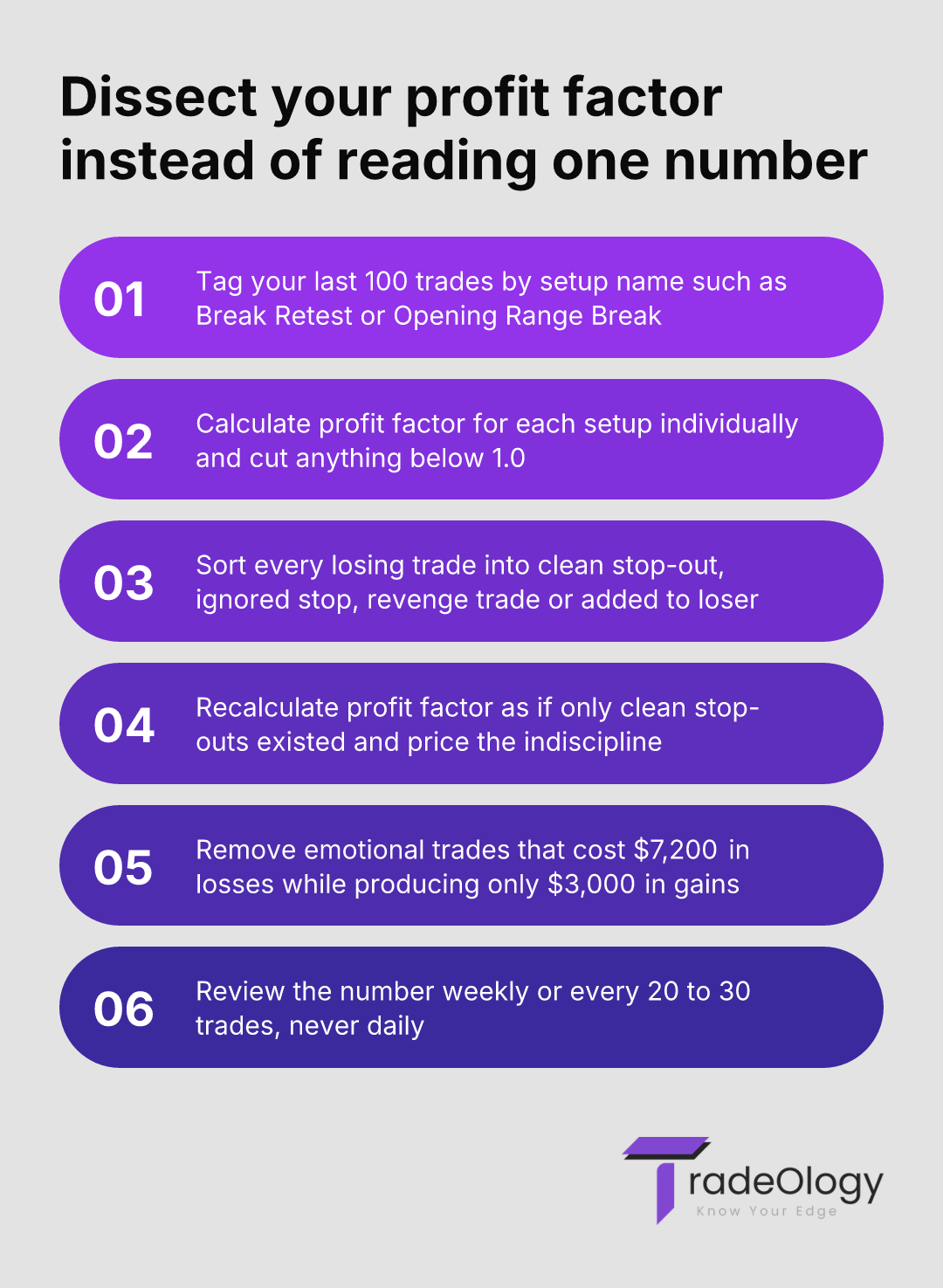
Go through your last 100 trades. Every trade must have a "Strategy" or "Setup" tag. Be specific: "Break/Retest," "Opening Range Break," "Mean Reversion 50MA," "Momentum Flag." Now, calculate the profit factor for each setup individually.
You will likely find that one or two setups have a profit factor of 2.5 or higher. You will also find setups with a profit factor below 1.0—these are the ones actively draining your account. The trades you take that don't fit any defined setup will almost certainly have a disastrous profit factor. These are the impulse trades, the FOMO chases, the boredom entries.
The actionable step is obvious: stop trading the negative-expectancy setups. Entirely. It feels like you’re limiting your opportunities, but you are not. You are cutting a cancerous growth from your P&L. Your goal is not to trade more; it is to make more money. This single filter is often enough to dramatically improve a trader's bottom line.
Step 2: Attack the Denominator (Your Gross Loss)
Most traders instinctively try to increase the numerator (gross profit) by finding more winning trades. This is the slow, hard path. The fastest way to increase your profit factor is to shrink the denominator (gross loss). This is about more than just having a stop loss; it’s about managing losing trades with ruthless efficiency.
Review every losing trade from the past quarter. Categorize them:
Clean Stop-Out: The setup was valid, you followed your plan, and the trade hit your pre-defined stop loss. This is the cost of doing business.
Mental Stop Ignored: The trade moved against you, blew past your mental stop, and you let it run, hoping it would come back. The loss was 2-3x larger than it should have been.
Revenge Trade: You took an immediate loss and jumped back in to "make it back," resulting in a second, often larger, loss.
Cost-Average Loser: You added to a losing position, violating the cardinal rule of trading. The loss became catastrophic.
Calculate your profit factor. Now, calculate what it would have been if you had eliminated every loss from the last three categories and only taken the "clean" stop-outs. The difference is usually shocking. It’s the price you pay for indiscipline. A better profit factor doesn’t require a better strategy; it often just requires better adherence to the strategy you already have. Your primary focus for strategy optimization should be on minimizing unnecessary losses, not just maximizing gains.
A Practical Example: The Illusion of a $50k Account
Consider a trader with a $50,000 account. Over 60 trading days, their P&L shows a net profit of $4,800. They feel successful. But let's look at the components:
Gross Profit: $22,000
Gross Loss: $17,200
Profit Factor: $22,000 / $17,200 = 1.28
A profit factor of 1.28 is fragile. This trader is working extremely hard to essentially tread water. They are taking on significant risk for a small net return. Now, let's apply our analysis. They use a trading journal and discover that $7,200 of their gross loss came from unplanned, emotional trades taken outside their core strategy. These trades only produced $3,000 in gross profit.
Let's see what happens when we surgically remove those trades:
New Gross Profit: $22,000 - $3,000 = $19,000
New Gross Loss: $17,200 - $7,200 = $10,000
New Net Profit: $9,000
New Profit Factor: $19,000 / $10,000 = 1.9
By simply ceasing to do what they already knew was wrong, the trader nearly doubles their net profit and creates a much more robust system with a 1.9 profit factor. Their P&L is higher, their drawdowns are smaller, and their stress is lower. They take fewer trades but make more money. This is the power of focusing on the right metric.
How TradeOlogy Forces This Honesty
A spreadsheet is better than nothing, but it’s clumsy. It creates friction, and traders are experts at avoiding friction that forces self-reflection. TradeOlogy is built to make this kind of analysis immediate and unavoidable.
Instead of manual calculations, you can apply tags like "A+ Setup," "Impulsive," or "Bad Execution" to your trades as they happen or during your review. From there, the analytics are automatic. You can see the profit factor for each tag with a single click. The platform can show you, in raw P&L numbers, how much your "FOMO" tag is costing you each month.
This isn’t about a clean dashboard; it’s about a direct feedback loop. When you can instantly see that your profit factor on Mondays is 0.8 while on Wednesdays it's 2.4, your behavior changes. When you see that trades held for more than two hours have a declining profit factor, you learn to take profits more effectively. It automates the brutal honesty that is essential for real strategy evaluation.
Common Mistakes in Using Profit Factor
Obsessing over a small sample size: A profit factor calculated from 10 trades is meaningless noise. You need a statistically relevant number of trades (50 at an absolute minimum, 100+ is better) for the metric to be reliable.
Ignoring commissions and slippage: Your profit factor calculation must use net gains and net losses. Forgetting to include trading costs can make a losing system look marginally profitable. Check your broker reports.
Confusing it with expectancy: They are related but different. Trading expectancy tells you what you can expect to make on average per trade. Profit factor gives you a holistic view of the system's health. Both are crucial.
Aiming for an "infinite" profit factor: If you have no losing trades, your profit factor is infinite. This usually means you are not trading enough, not taking valid risks, or closing trades at the first tick of profit, leaving huge potential gains on the table. A very high profit factor (>4.0) can be a sign of inefficient capital deployment.
Frequently Asked Questions
What is a good profit factor in trading?
This depends heavily on the strategy and trading frequency. For a high-frequency scalping strategy, a profit factor of 1.4 might be very strong. For a swing trading strategy, you should aim for 2.0 or higher. Generally, a value below 1.5 is a warning sign that the system is not robust. A value above 2.0 indicates a very healthy and profitable system.
Can I improve my profit factor without changing my strategy?
Yes. This is a critical point. Many traders have a winning strategy but mask it with poor execution. By simply eliminating unplanned, emotional trades and managing losers more effectively (e.g., not widening stops), you can dramatically increase your profit factor without altering your core entry signals at all.
How often should I check my profit factor?
Do not check it daily. This will lead to emotional decisions. Review it on a weekly or monthly basis, or after every 20-30 trades. The goal is to evaluate your system's performance over a meaningful sample size, not to micromanage the outcome of individual trades.
The Final Standard
Your P&L is a story. Your profit factor is the math. One can be spun into whatever you want to believe; the other is an objective measure of your system’s viability. Any trader can get lucky on an oversized position. A professional, however, builds a system with a healthy engine that can withstand the normal friction of the market—losing streaks, difficult conditions, and unexpected events. The entire goal of effective profit factor trading is to build that resilient engine, ensuring that for every dollar you put at risk and lose, your winners deliver a multiple of that back to your account. Anything less is just gambling with extra steps.