

Trading discussions often revolve around one number: win rate. You’ll see traders brag about a 70% win rate or claim they have a strategy that wins most of the time. But the reality is that win rate alone means almost nothing.
A strategy can win 80% of the time and still lose money. Another strategy might win only 40% of the time and still be extremely profitable. The real metric that determines whether a trading strategy works is expectancy.
If you want to improve your trading performance, you need to understand how expectancy works and how to measure it.
What Is Trading Expectancy?
Expectancy measures the average amount you can expect to win or lose per trade over time. It combines two important factors: win rate and risk-to-reward ratio.
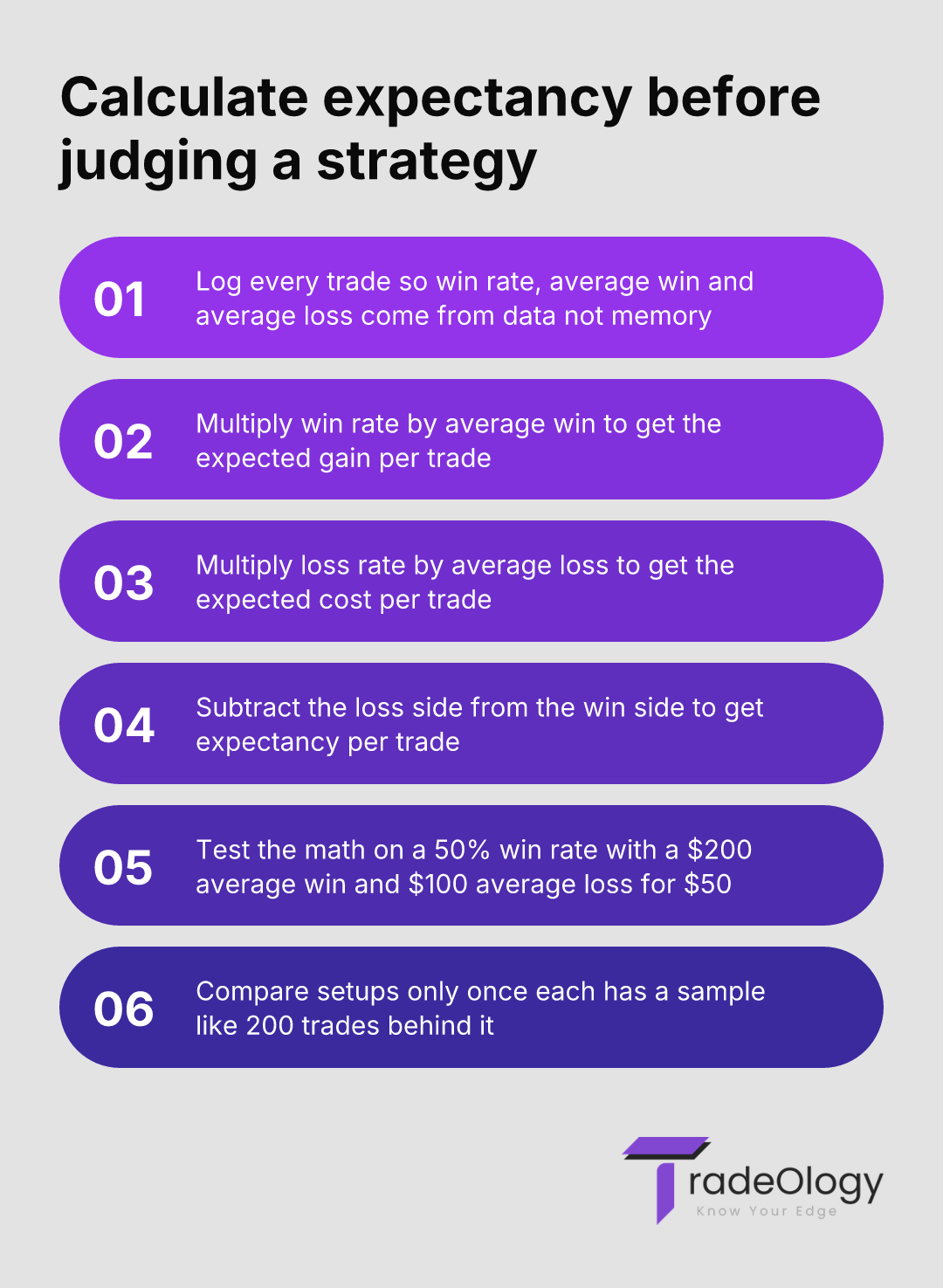
The formula is simple: expectancy equals win rate multiplied by average win, minus loss rate multiplied by average loss.
For example, imagine a trader wins 50% of trades. The average win is $200 and the average loss is $100. The expectancy would be $50 per trade. Over a large sample size, every trade is worth $50 on average. This is what separates profitable strategies from losing ones.
Why Win Rate Is Misleading
Many beginner traders focus entirely on winning more trades. A high win rate feels good psychologically because traders like being right. But profitability depends on the relationship between wins and losses.
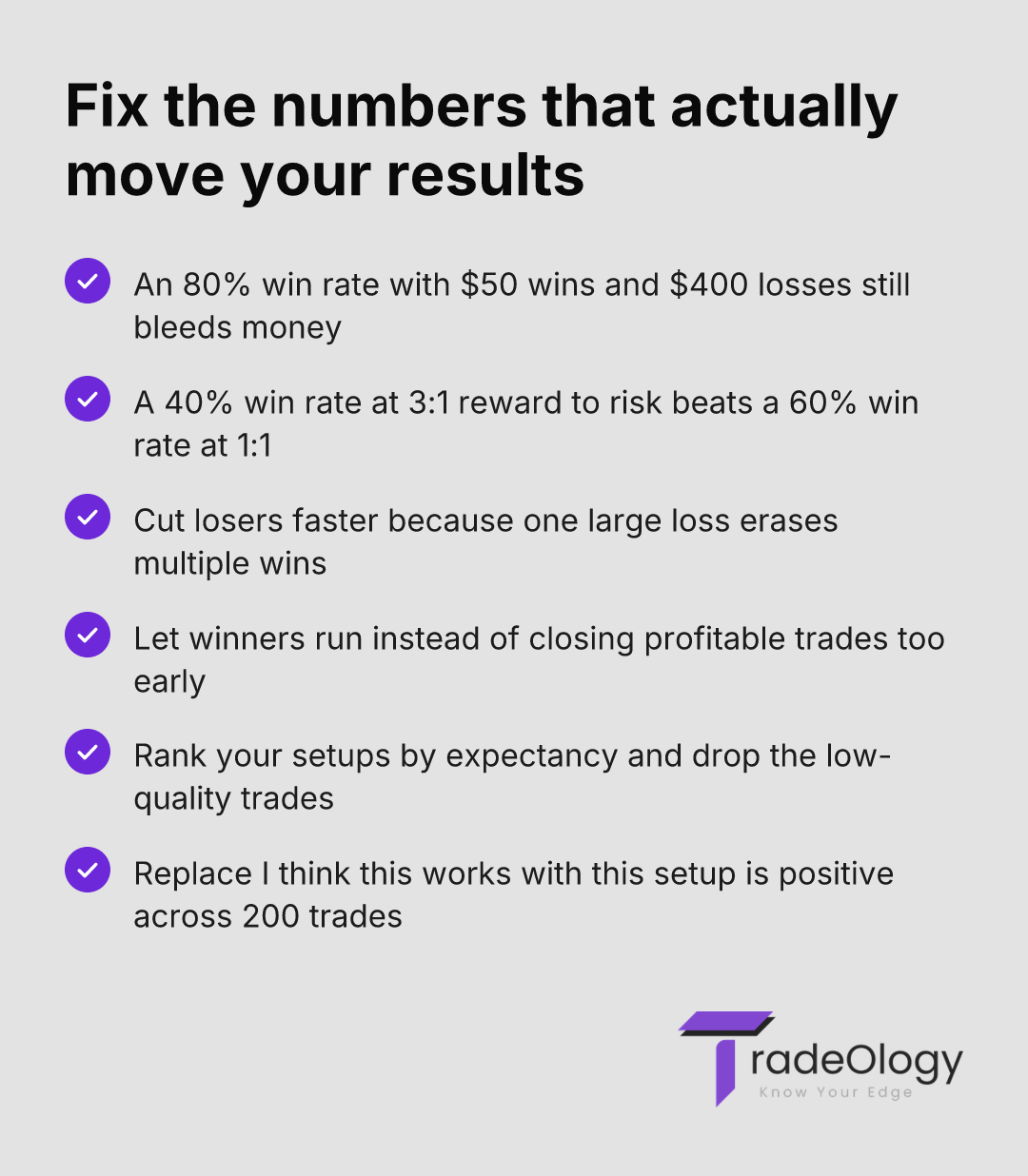
Consider this example. Trader A has a win rate of 80%, but the average win is only $50 while the average loss is $400. Even though most trades are winners, one large loss can erase multiple wins.
Now consider Trader B. This trader wins only 45% of trades, but the average win is $300 while the average loss is $100. Despite losing more trades, Trader B is significantly more profitable.
The difference comes down to expectancy, not win rate.
The Role of Risk-to-Reward
Risk-to-reward is one of the most important components of trading expectancy. A trader who consistently risks $100 to make $300 does not need to win most trades to be profitable.
For example, a strategy with a 40% win rate and a 3:1 reward-to-risk ratio can outperform a strategy with a 60% win rate and a 1:1 ratio.
This is why professional traders care far more about risk management than about being right on every trade.
Why Most Traders Never Calculate Expectancy
The main reason traders ignore expectancy is simple: they do not track their trades.
Without detailed data, it is impossible to calculate your real win rate, average win, average loss, or performance by setup. Traders often rely on memory, which is extremely unreliable when money and emotions are involved.
This is exactly why serious traders use a trading journal.
If you haven’t read it yet, this article explains why tracking trades is critical: Why Most Traders Fail Without a Trading Journal.
Tracking your trades gives you the raw data needed to calculate real strategy performance.
Example of Expectancy in Practice
Imagine two traders using different strategies.
Trader A has a 70% win rate. The average win is $80 and the average loss is $250.
Trader B has a 45% win rate. The average win is $350 and the average loss is $120.
At first glance, Trader A appears more successful. However, when expectancy is calculated, Trader B is far more profitable. Over hundreds of trades, the difference becomes dramatic.
This is why professional traders analyze performance metrics rather than focusing only on wins and losses.
How to Improve Trading Expectancy
Improving expectancy does not necessarily require finding a brand-new strategy. Often, small adjustments to execution can have a major impact.
First, cut losing trades faster. Large losses destroy expectancy. Improving stop-loss discipline can significantly improve results.
Second, let winning trades run. Many traders exit profitable trades too early. Increasing the size of winning trades can dramatically improve overall expectancy.
Third, identify high-performance setups. When you track trades properly, you can see which setups produce the best results.
Finally, eliminate low-quality trades. Sometimes the best improvement comes from simply trading less and focusing only on your strongest setups.
Why Data Changes Everything
Most traders operate based on emotion and memory. But memory is selective. Traders remember big wins and forget consistent losses.
Data removes the guesswork.
Instead of saying, “I think this strategy works,” you can say, “This setup has positive expectancy across 200 trades.”
That level of clarity fundamentally changes how traders approach the market.
How TradeOlogy Helps Traders Measure Expectancy
Calculating expectancy manually can be tedious. TradeOlogy automates the process by analyzing your trading history.
With TradeOlogy, traders can quickly see win rate, average win versus average loss, strategy performance, execution quality, and long-term consistency.
Instead of guessing whether a strategy works, you can measure it with real data and make informed decisions.
Final Thoughts
Winning more trades does not automatically mean better performance. What truly matters is whether your strategy has positive expectancy over time.
Successful traders focus on analyzing their performance, measuring outcomes, and refining their strategies based on data.
If you want to improve your trading results, stop focusing only on win rate and start measuring the numbers that actually matter.
Start Tracking Your Strategy Performance
If you are serious about improving your trading, the first step is tracking your performance data.
TradeOlogy helps traders analyze trades, measure strategy performance, and identify what actually works.
Start journaling your trades with TradeOlogy and discover the real performance behind your strategy.