
Your P&L Is Leaking and Your So-Called Journal Is the Reason
You have a spreadsheet. It has columns: Entry, Exit, P&L, Strategy. You fill it out. You feel disciplined. And yet, your equity curve looks like a bad EKG, and you have no real idea why last month was green and this month is a disaster.
You do not have a trading journal. You have a trade log. You are doing clerical work and calling it analysis. This is not a small distinction. It is the entire reason your performance is unstable. The market is not your problem. Your system is not your problem. Your refusal to acknowledge the trading journal vs trade log difference is the hole in your process.
A trade log is a receipt. It proves something happened. A trading journal is a diagnostic. It exposes why it happened, and what specific behavior is wrecking your performance. You are celebrating the receipt and ignoring the diagnosis.
That Is Not the Real Problem. This Is.
Traders love data because it feels objective. Win Rate, R-Multiple, Average Gain. These numbers feel solid. So you log them, you make pivot tables, you calculate your stats. You are busy, but you are not productive.
The core failure is this: Your trade log tells you what your strategy’s statistics are. Your journal is supposed to tell you what your statistics are when you attempt to execute that strategy. The gap between those two data sets is where every dollar you lose is made.
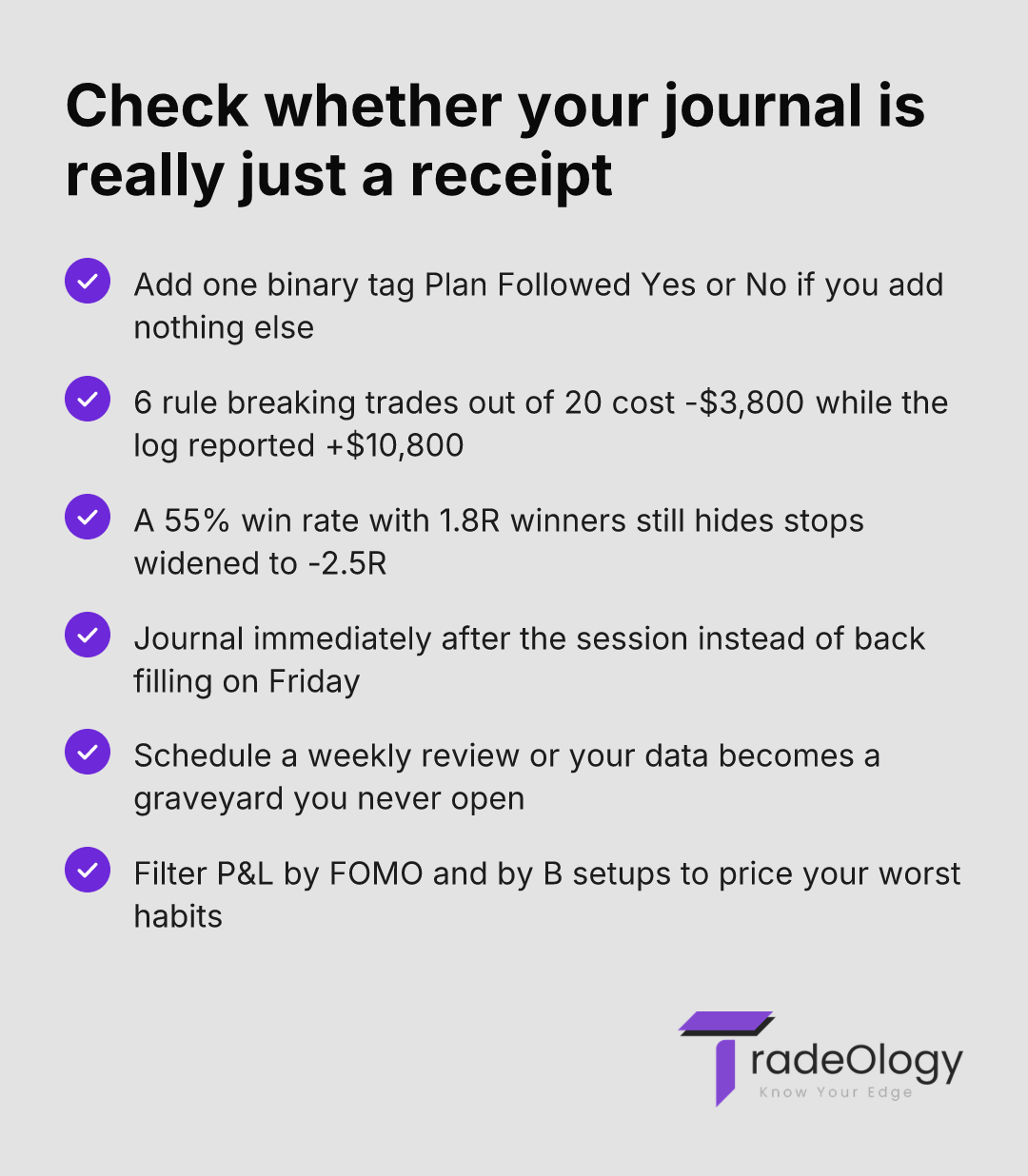
Your log shows a 2:1 reward-to-risk target. But your journal would show you took profit at 1.2R on five straight winners because you were scared. Your log shows a stop-loss set at -1R. Your journal would show you moved it "just a little" on three occasions, turning -1R losses into -2.5R account dents. Your log says you trade the "A+ Setup". Your journal would show you’re taking B- setups out of boredom and they have a negative expectancy.
You are bleeding money in the execution, not in the strategy design. Your trade log hides this reality. It lumps everything together. A proper journal isolates the self-sabotage.
Understanding the Trading Journal vs Trade Log Difference in Practice
Most traders stop recording data once the trade is closed. That is exactly where the damage starts. The log is just the raw material. The journaling is the interrogation of that material.
A log answers: "What was the result?"
A journal answers: "Why was the result what it was, and how much did my behavior deviate from my plan?"
Stop thinking of them as the same thing. They are two distinct, sequential processes.
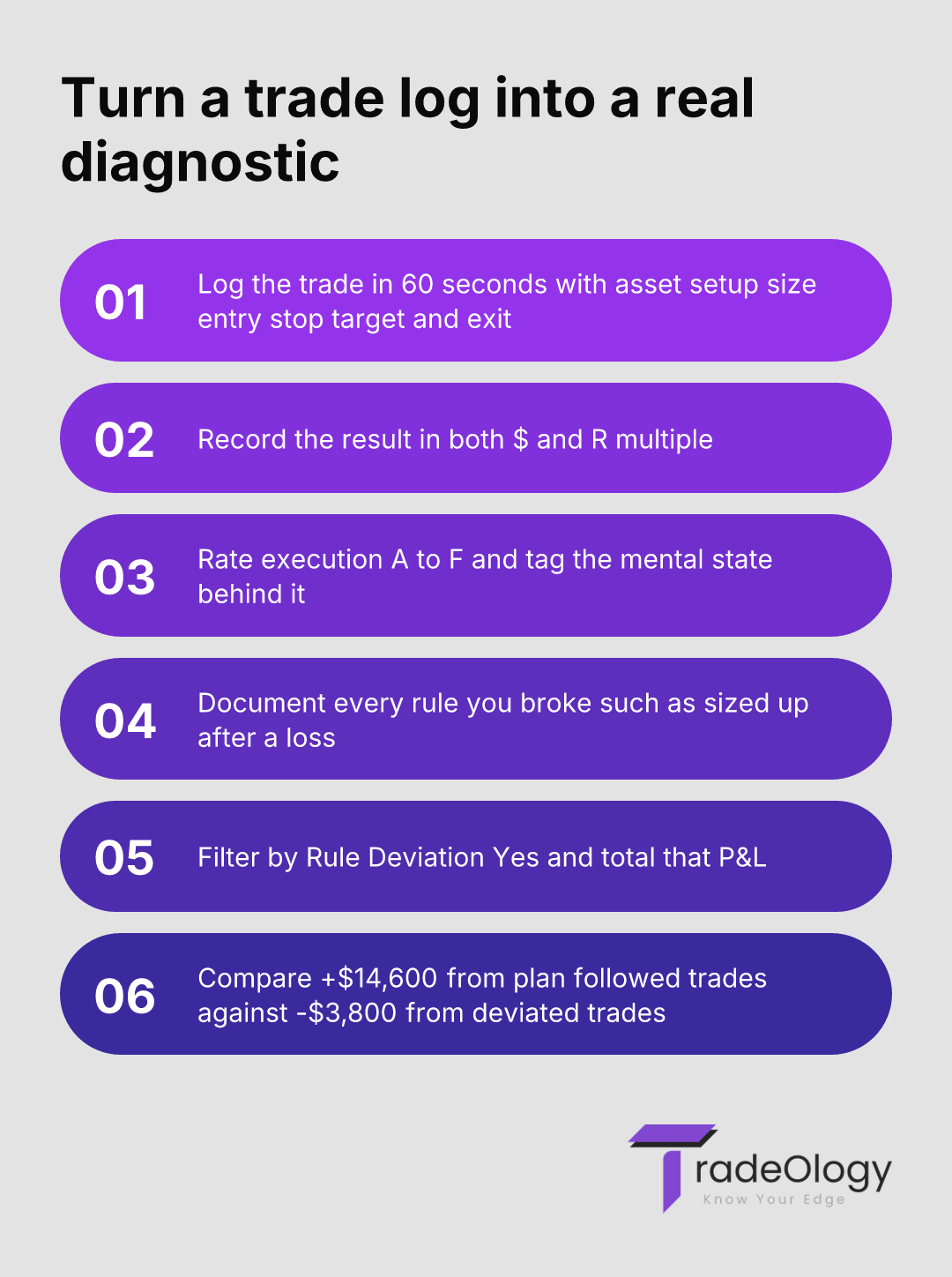
The Log: Cold, Hard Data Entry. This part is fast and objective. It should take 60 seconds.
Asset
Strategy Name/Setup
Position Size
Entry Price & Time
Initial Stop Loss & Target
Exit Price & Time
P&L ($ and R-Multiple)
The Journal: The Qualitative Interrogation. This is where the work is done. It requires brutal honesty.
Execution Rating (A-F): Did you follow your plan to the letter? (A) Or did you chase the entry, exit early, and move your stop? (F)
Mental State: Were you focused,FOMO, angry, bored? Tag it.
Rule Deviations: Document every single rule you broke. "Sized up after a loss." "Traded outside my window." "Ignored a news catalyst."
Screenshot with Commentary: Mark up your chart. Where was the planned entry? Where did you actually get in? Why?
You think you fixed this. You did not. A clean dashboard does not fix a broken process. Better review does. The goal is not to have a pretty spreadsheet. The goal is to isolate your most expensive habits.
A Real-World Example: Where the Money Disappears
Let's look at a trader with a $100,000 account, risking $1,000 (1R) per trade.
The Trade Log View (The Lie):
Total Trades: 20
Wins: 11 (55% Win Rate)
Losses: 9
Average Winner: +$1,800 (+1.8R)
Average Loser: -$1,000 (-1R)
Net P&L: (11 * 1800) - (9 * 1000) = $19,800 - $9,000 = +$10,800
This looks great. The trader thinks their system is sound. They made money. They are a profitable trader this month.
The Journal View (The Truth):
Now we use the journal’s qualitative tags to run a real review. We filter by "Rule Deviation: Yes".
Trades with Rule Deviations: 6 of the 20
Breakdown of those 6 trades:
2 wins, where the trader "got lucky" chasing an entry. P&L: +$2,400
4 losses, where the trader widened stops or entered impulsively. P&L: -$6,200
Net P&L of Deviated Trades: -$3,800
Now let's look at the trades where the plan was followed perfectly.
Trades with Zero Deviations: 14
Net P&L of "Plan Followed" Trades: $10,800 (Total P&L) - (-$3,800) = +$14,600
This is the insight that matters. The trader’s actual strategy, when executed correctly, is far more profitable than they realize. Their undisciplined, impulsive actions are costing them $3,800 directly and creating immense emotional drag. The log masks this; the journal reveals it with painful clarity. This trader's only job is to eliminate the deviated trades. The trade review process is not about admiring winners; it's about dissecting errors.
Common Mistakes That Keep You Stuck
You are making these mistakes because you treat your journal like a log. Stop.
You log but you never review. You have a graveyard of data you never look at. It's useless. Schedule a weekly review and stick to it.
You only track quantitative data. You ignore your psychological state and execution quality, which are the root causes of your P&L swings.
You fill it out at the end of the week. You are back-filling with revisionist history. Journal immediately after your trading session while the reasons and emotions are raw and real.
You focus on win rate. A high win rate with poor risk management or early profit-taking is a path to ruin. Your journal will show you that your expectancy is what matters, and your behavior is likely destroying it.
How TradeOlogy Forces Honesty
A spreadsheet allows you to lie to yourself. It makes it easy to record the basic log data and skip the hard part. That is its weakness.
TradeOlogy is built to automate the log and enforce the journal. It automatically imports your trades from your broker. The boring data entry is done. Your job is not to be a clerk. Your job is to be a performance analyst.
This is where it makes a difference. With TradeOlogy, you are forced to confront the qualitative aspects. The platform is designed for you to tag your trades with your custom rules and psychological states. You then use the analytics dashboard to run the exact filters we just discussed.
In two clicks, you can see your P&L for "FOMO" trades. You can compare the performance of your "A+" setups versus your "B" setups. You can instantly see how much money your habit of "Moving Stop Loss" is costing you over the last quarter. The software is a mirror, not a crutch. It doesn't fix your problems. It shows you exactly where they are so you can.
FAQ
Can my trade log just be a simple spreadsheet?
Yes, but that is all it will ever be: a log. A simple record. It lacks the structure and tools for the deep behavioral analysis that a real journal provides. It makes it too easy to focus on simple P&L and ignore the execution metrics that actually drive performance.
What is the most important field to have in a trading journal?
A simple, binary tag: "Plan Followed (Yes/No)". If you track nothing else, track this. At the end of the month, compare the aggregate P&L of your "Yes" trades to your "No" trades. The result will force you to change your behavior.
How often should I be journaling vs reviewing?
Journal after every single trading session without fail. The data is freshest. Review your data weekly. This is non-negotiable. The weekly review is where you connect the dots between individual trade mistakes and broader patterns in your P&L.
My current journal feels like a waste of time. Why?
Because you are using it as a log. You are recording what happened and stopping there. It feels useless because it is. You are not asking the hard questions. You are not filtering by behavior. You are not calculating the cost of your mistakes. A journal only becomes your most crucial tool when you use it for interrogation, not just for record-keeping.
The Log Is a Record. The Journal Is the Reckoning.
Stop confusing the two. A trade log proves you were busy. A trading journal is the tool you use to become profitable. It exposes the patterns that your ego and your emotions work so hard to hide. In 2026, with the tools available, there is no excuse for flying blind.
The core of your work as a trader is not finding a better strategy; it's finding a way to execute the one you have flawlessly. The data for that is not in your strategy’s backtest. It’s in your behavior. The only way to see that is to finally understand the trading journal vs trade log difference and get to work on the part that matters.