

When it comes to trade review process, understanding the fundamentals is essential for any trader.
Mastering the Trade Review Process for Data-Driven Decisions
Did you know that top-performing traders consistently dedicate 30-60 minutes daily to analyzing their past trades? This adherence to a structured trade review process is not merely a formality; it is a fundamental pillar of sustained profitability and continuous improvement. Without a rigorous and objective review of trading activity, even the most promising strategies can falter, leading to repeated mistakes and stagnant growth.
The Problem: Trading Without Reflection
Many traders, especially those new to the markets, often fall into the trap of focusing solely on entries and exits. They chase the "next big trade," rarely pausing to understand the "why" behind their wins and losses. This lack of reflection leads to several critical issues:
Reinforcement of Bad Habits: Without identifying what went wrong, traders are prone to repeating costly errors, whether it's poor risk management, emotional decision-making, or deviation from their established plan.
Inconsistent Strategy Application: A strategy only works if applied consistently. Without reviewing trades, it's difficult to discern if a strategy is genuinely underperforming or if it’s being executed inconsistently.
Emotional Biases Unchecked: Trading can be an emotional rollercoaster. A proper trade review helps to objectively identify instances where fear, greed, or impatience influenced decisions, allowing traders to develop mechanisms to mitigate these biases.
Stagnant Performance: Without data-driven insights into what works and what doesn't, a trader's performance often plateaus or declines. Growth becomes anecdotal rather than systematic.
Explanation: What Constitutes a Thorough Trade Review Process?
A comprehensive trade review process is a systematic examination of every aspect of a completed trade, from initial conception to final closure. It moves beyond simply checking profit and loss (P&L) and delves into the qualitative and quantitative factors that influenced the outcome. The goal is not to dwell on past mistakes in a punitive way, but rather to extract actionable insights that can be applied to future trading decisions. This involves scrutinizing market conditions, analyzing entry and exit efficiency, evaluating risk management protocols, and assessing psychological factors.
Consider the market context: What was the broader market trend? Were there significant news events or economic data releases that impacted price action? Analyzing these external factors helps gauge if the trade was aligned with prevailing market sentiment. Internally, the review focuses on adherence to the trading plan. Was the entry taken according to the predefined setup rules? Was the stop-loss placed correctly? Was the take-profit target appropriate given the market volatility and potential? Furthermore, the psychological aspect is crucial. What was the trader's mental state? Were decisions made rationally or impulsively? Identifying these patterns is vital for holistic improvement.
Practical Framework: A Step-by-Step Methodology for Trade Analysis
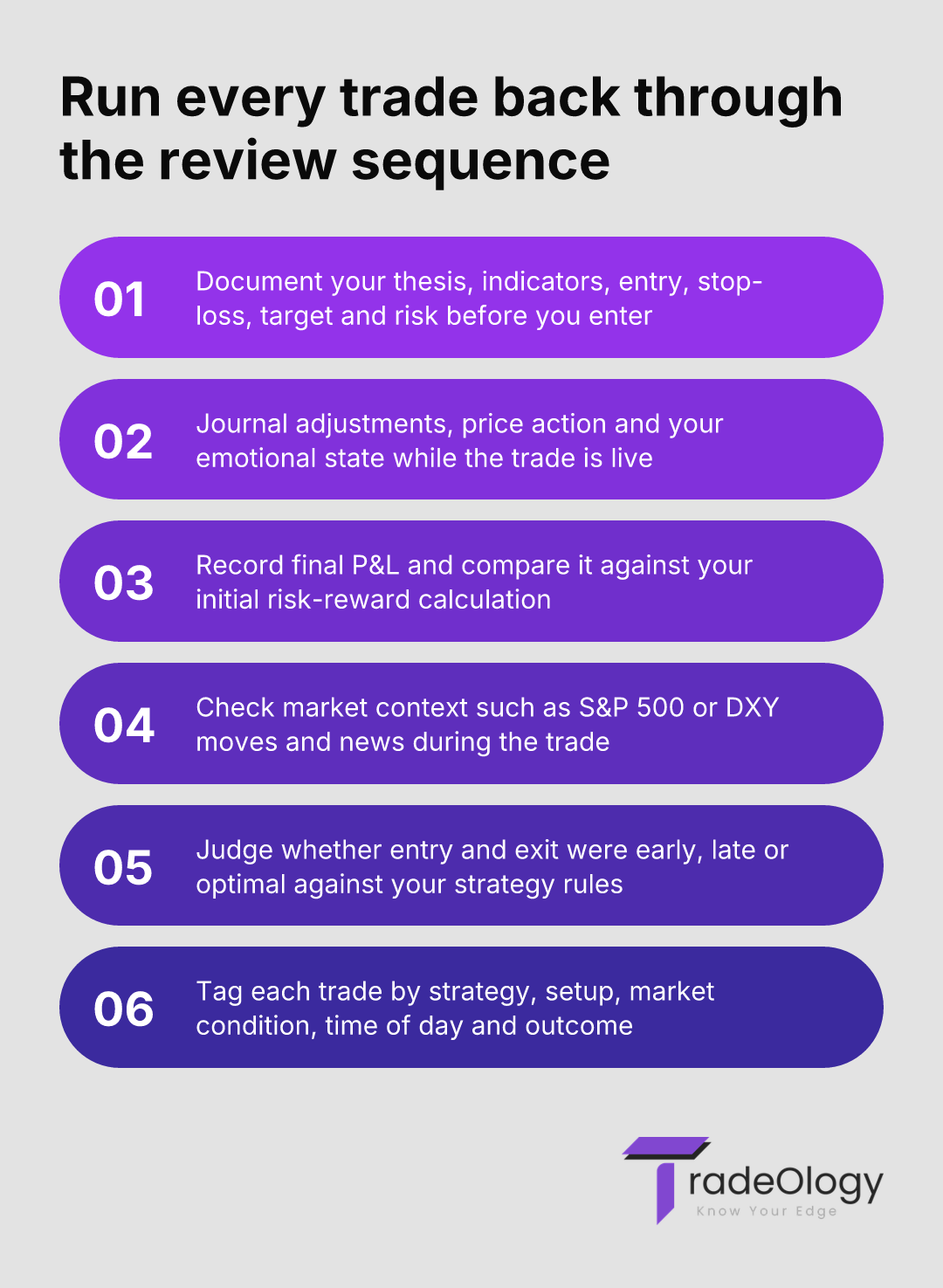
1. Initial Data Capture (Pre-Trade & During Trade)
Pre-Trade Analysis: Before entering, document your reasoning. What is your thesis? What indicators are you using? What are your entry, stop-loss, and target levels? What is your calculated risk per trade?
During-Trade Journaling: Note any adjustments made, significant price action, and your emotional state at key points. Include screenshots of your charts at entry, during the trade, and at exit.
2. The Post-Trade Review Session
Objective P&L Assessment: Record the final profit or loss. Link it to your initial risk calculation to understand your actual risk-reward ratio achieved.
Market Context Analysis: Review the broader market conditions (e.g., S&P 500 movement for equity traders, DXY for forex traders) during the trade. Were there any relevant economic reports or news?
Entry and Exit Analysis:
Did the entry conform to your strategy rules? Was it optimal, early, or late?
Was the exit executed according to your plan? Was it premature, or did you hold on for too long? Could you have achieved a better price?
Risk Management Evaluation:
Was your stop-loss placed correctly and honored?
Was the position size appropriate for your account and strategy?
Did you adhere to your trading expectancy parameters?
Psychological State Assessment: Reflect on your emotions. Were you fearful, greedy, impatient, or disciplined? How did these emotions influence your decisions? Be honest with yourself.
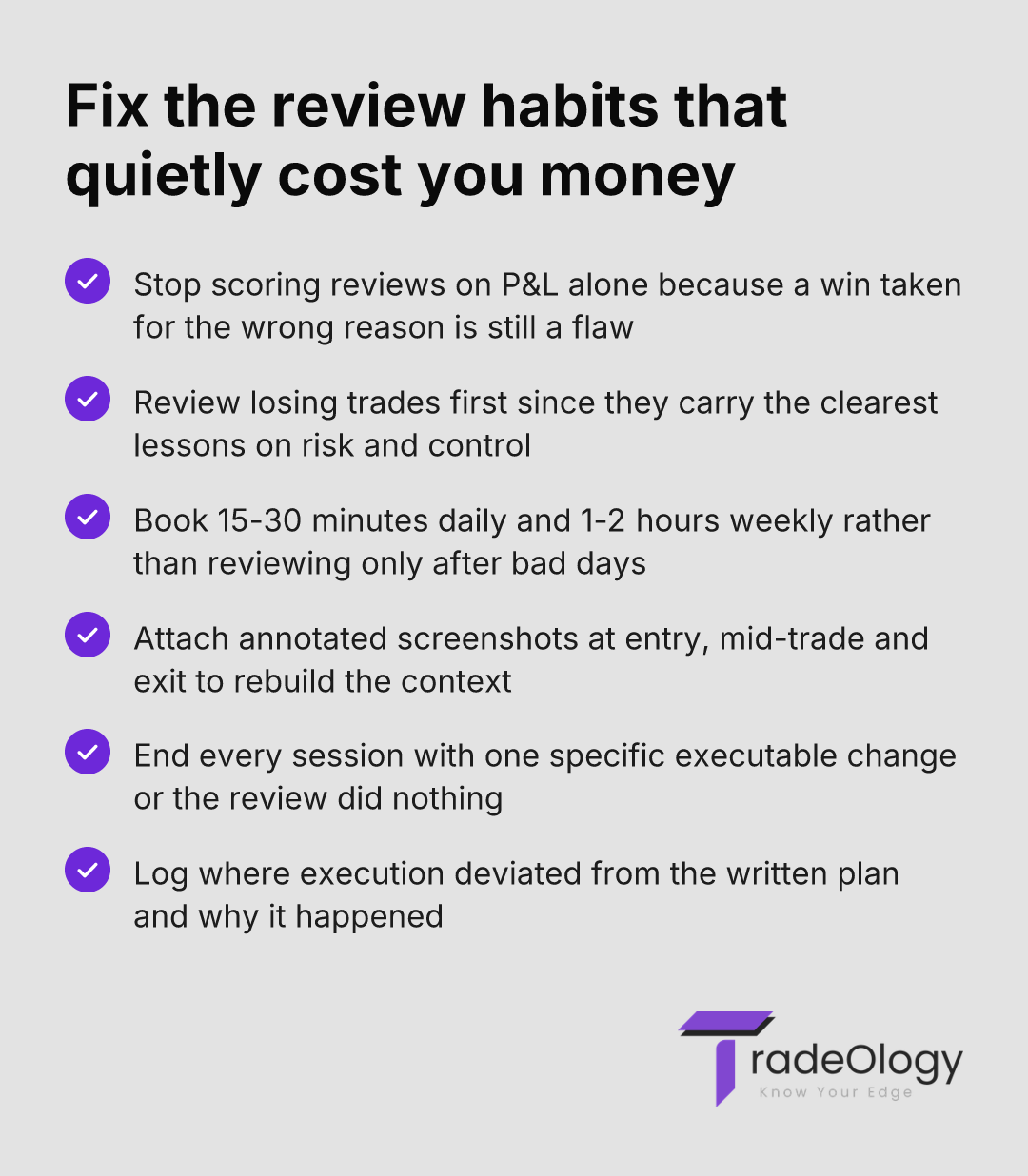
Identify Deviations: Compare your actual trade execution against your predefined plan. Where did you deviate, and why?
3. Categorization and Pattern Recognition
Tagging Trades: Categorize trades by strategy, setup type, market conditions, time of day, and outcome. This allows for statistical analysis.
Monthly/Quarterly Review: Aggregate your trade data over longer periods. Identify recurring patterns in your performance. Are certain strategies more profitable in specific market conditions? Are there particular times of day when you underperform?
For more insights into structured journaling, consider reading Why Most Traders Fail Without a Trading Journal.
Common Mistakes to Avoid in Your Trade Review Process
Focusing Only on P&L: The dollar amount is merely an outcome. The process leading to it is far more important for learning. A profitable trade done for the wrong reasons is just as problematic as a losing trade.
Emotional Self-Flagellation: Reviews should be objective, not an opportunity for self-criticism. Focus on data and actionable insights, not regret.
Skipping Losing Trades: It’s tempting to only review winners, but losing trades often provide the most valuable lessons about risk management, strategy flaws, or emotional control.
Lack of Consistency: An inconsistent review process yields inconsistent results. Integrate it into your daily trading routine.
No Actionable Takeaways: The purpose of a review is to identify areas for improvement. If you're not deriving specific, executable changes to your approach, the review is ineffective.
Not Using Visuals: Static screenshots or video recordings of your charts with annotations are invaluable for revisiting the context of the trade.
How TradeOlogy Helps with Your Trade Review Process
TradeOlogy is specifically designed to streamline and enhance your trade review process. Our platform provides intuitive tools for comprehensive trade logging, allowing you to capture all the essential data points – from entry and exit prices to risk metrics and psychological notes. With customizable tags and advanced filtering capabilities, you can categorize your trades effortlessly, making pattern recognition and performance analysis a straightforward task.
Our robust charting integration allows you to upload and annotate screenshots directly within your trade entries, providing a visual record of your decisions. Furthermore, TradeOlogy’s detailed analytics generate insightful reports on your performance across various strategies, setups, and market conditions. This data-driven feedback highlights your strengths and weaknesses, enabling you to refine your trading approach with precision, reduce costly errors, and ultimately improve your overall profitability. The platform transforms raw trade data into actionable intelligence, ensuring your reviews are always productive and lead to measurable trading growth.
FAQ
Q: How often should I conduct a trade review?
A: Ideally, a brief review should be done after every trading session, focusing on the day's trades. A more in-depth weekly or monthly review is crucial for identifying broader patterns and refining your strategy. Consistent daily reviews are optimal for rapid learning.
Q: What is the most important aspect of a trade review?
A: While all aspects are important, objectively assessing deviations from your trading plan and identifying psychological influences on your decisions are arguably the most critical. Understanding "why" you acted as you did provides the deepest insights for improvement.
Q: Should I review winning trades as thoroughly as losing trades?
A: Yes, absolutely. Reviewing winning trades helps reinforce good habits and identify what you did correctly. A win can sometimes occur due to luck rather than sound strategy, and reviewing it helps distinguish between the two for consistent performance over time.
Q: How long should a trade review take?
A: A daily review might take 15-30 minutes, while a more comprehensive weekly review could take 1-2 hours, depending on your trading volume. The key is thoroughness and consistency, not speed.
Conclusion
The trade review process is an indispensable component of successful trading. It transcends simple profit and loss accounting, serving as a powerful feedback loop that drives continuous improvement. By systematically analyzing your trades – focusing on market context, execution efficacy, risk management, and psychological influences – you can transform subjective trading experiences into objective, data-driven insights. Embracing a rigorous review methodology allows traders to identify recurring patterns, correct costly mistakes, and refine their strategies, ultimately paving the way for consistent and sustainable profitability. Remember, every trade, win or loss, is an opportunity to learn and grow. A well-executed trade review ensures you capitalize on that opportunity.