

'''
When it comes to trading journal, understanding the fundamentals is essential for any trader.
Why Your Trading Performance Hinges on One Tool
Picture this: It’s the end of a long trading week. You’re staring at a sea of red in your P&L, nursing a painful drawdown. You feel frustrated, undisciplined, and completely lost about what went wrong. You took some good trades, you think, but the losses overshadowed them. Now contrast that with a professional trader. After a losing week, they aren’t guessing; they’re analyzing. They open their trading journal, filter for their losing trades, and examine the data: the setups, the time of day, their psychological state, and their adherence to the plan. The difference between the struggling trader and the professional isn’t a secret indicator; it’s a systematic process of review. The single most important tool in that process is a high-quality trading journal. It transforms trading from a gut-feel gamble into a data-driven business.
The Quick Formula for Trader Improvement
Data-Driven Insight = (Trade Data + Context) x Systematic Review
This isn't just about logging wins and losses. It’s about capturing the full context of each trade—your thesis, emotions, and the market environment—and then rigorously reviewing that data. For example, logging 50 trades might reveal that while your overall win rate is 50%, your win rate for trades placed after 2 PM EST is only 20%. That single insight is worth thousands in saved losses.
The Problem: Flying Blind and Repeating Mistakes
Most traders operate in a fog of cognitive biases and random reinforcement. You hit a 5R winner and feel like a genius, conveniently forgetting the seven small losses that preceded it. Without objective data, you are your own worst enemy. The primary struggle is the inability to distinguish between a good process and a lucky outcome. Was that profitable trade a result of a well-executed strategy, or did you just get lucky on a FOMO entry?
This lack of clarity leads to the classic cycle of unprofitable trading: a trader develops a strategy, tests it with a few trades, experiences a drawdown, loses confidence, and then jumps to a new strategy. They never stick with one system long enough to gather meaningful performance data. They blame the strategy, the market, or their tools, but the real issue is the absence of a feedback loop. A detailed trading log is that feedback loop. Without it, you’re simply guessing, and guessing is the fastest way to drain your trading account.
What a Modern Trading Journal Actually Is
Let’s be clear: a modern trading journal is not a simple diary where you jot down "Bought 100 shares of AAPL, sold for a profit." That’s a trade log. A true journal is a comprehensive database of your performance as a trader. It’s a tool for deep analytics, designed to answer critical questions about your behavior and strategy effectiveness.
While a basic spreadsheet is a start, a dedicated online trading journal elevates this process entirely. It should capture not just the quantitative data—entry price, exit price, position size, P&L—but also the qualitative context:
Screenshots: A snapshot of your charting setup at the time of entry and exit.
Strategy Tags: The specific setup you were trading (e.g., "Breakout," "Mean Reversion," "ORB").
Pre-Trade Thesis: Why did you take this trade? What was your plan?
Emotional State: Were you feeling patient, anxious, greedy, or fearful?
Mistake Analysis: Did you follow your plan? If not, where did you deviate?
This combination of hard data and qualitative observation is what allows you to move beyond P&L and start analyzing your actual trading decisions. A great trading decision can lead to a loss, and a terrible one can lead to a win. Your job is to focus on the quality of the decisions, and a proper trading journal is the only tool that makes that possible.
A Practical Framework for Effective Journaling
Knowing you need a journal isn’t enough. You need a process to make it the central hub of your trading operation. Here is a step-by-step framework to turn journaling from a chore into a powerful performance habit.
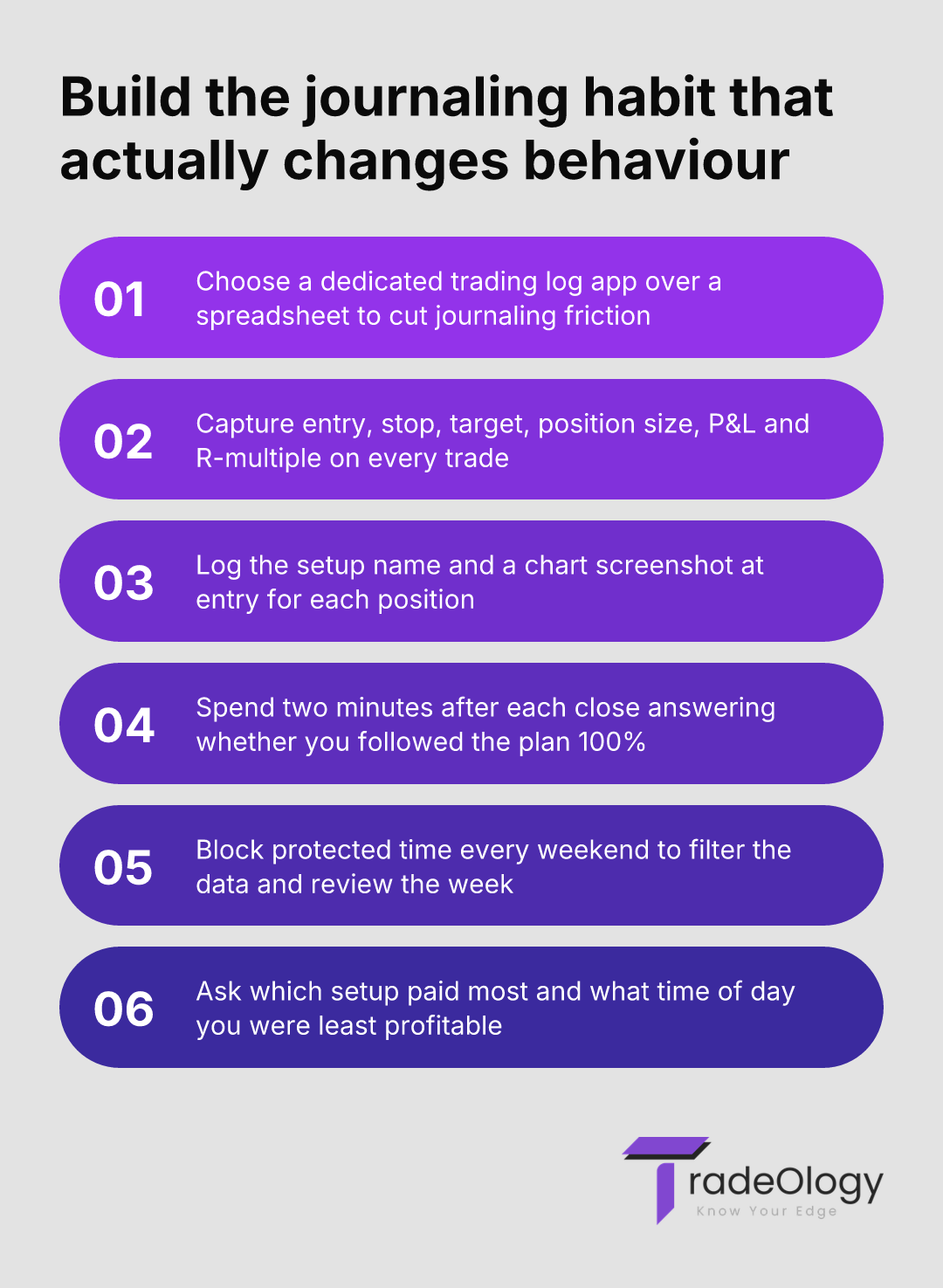
1. Choose Your Weapon: Spreadsheet vs. Dedicated Software
You can start with a simple spreadsheet (Google Sheets or Excel), but you will quickly find its limitations. Calculating metrics like expectancy or filtering by setup requires complex formulas. A dedicated trading log app like TradeOlogy is built for this. It can auto-import trades, tag setups, attach screenshots, and run advanced analytics with a few clicks. The less friction in the process, the more likely you are to stick with it.
2. Define Your Core Data Points
For every single trade, you must capture a consistent set of data. This is non-negotiable. Your journal should at a minimum include:
Instrument/Ticker
Date and Time of Entry/Exit
Long or Short
Entry Price, Stop Loss, and Target Price
Position Size (Shares, Contracts, Lots)
Final P&L and R-Multiple
Strategy/Setup Name
A screenshot of the chart at entry.
3. The Post-Trade Review: Capture the "Why"
Immediately after closing a trade, before entering the next one, take two minutes to complete the journal entry. This is when the context is freshest. Answer three simple questions:
Did I follow my trading plan 100%? (Yes/No)
What was the primary reason for my entry? (My pre-trade thesis)
What was the outcome and what can I learn from it? (My post-trade reflection)
This habit prevents you from carrying the emotional baggage of one trade into the next.
4. Schedule Your Weekly Review
This is where the magic happens. Set aside a protected block of time every weekend to conduct a full trade review. This is your business meeting with yourself. Open your trading journal and analyze your weekly performance. Look for patterns by filtering your data. Ask questions like:
What was my most profitable strategy this week?
What time of day was I most/least profitable?
What was my average R:R on winning vs. losing trades?
On which trades did I deviate from my plan, and why?
A Real Trading Example in Practice
Let's see how this works for a trader named Alex with a $50,000 account, risking 0.5% per trade ($250).
Alex sees a potential pullback buy on the SPY ETF. His plan is to wait for a bounce off the 21-period EMA on the 15-minute chart. However, he sees the price dip and feels anxious about missing the move. He enters early, 10 points above the EMA.
Setup: 15-min 21 EMA Retest
Entry: $545.00
Intended Stop Loss (per plan): $543.50 (below the EMA)
Actual Stop Loss: $543.50 (1.5 point risk)
Position Size: $250 risk / $1.50 = 166 shares.
The price continues to dip, touches the EMA perfectly, bounces, and heads toward his target. But his early entry and tight stop mean he gets stopped out for a $250 loss just before the real move happens. Without a journal, he might just curse his bad luck. With his journal, he logs the trade, tags it with the strategy, and crucially, adds a note: "Feelings: Impatient, FOMO. Mistake: Entered before the setup was confirmed, violating my entry rule."
Two weeks later, during his review, he filters for all losing trades tagged "15-min 21 EMA Retest." He discovers that 4 out of 5 losses had the same note: an early entry. The data in his trading journal proves his impatience is costing him money. He now has a data-driven reason to focus on discipline, not a vague feeling of "bad luck."
Common Journaling Mistakes That Invalidate Your Data
Using a journal incorrectly is almost as bad as not using one at all. Avoid these common pitfalls that sabotage your efforts:
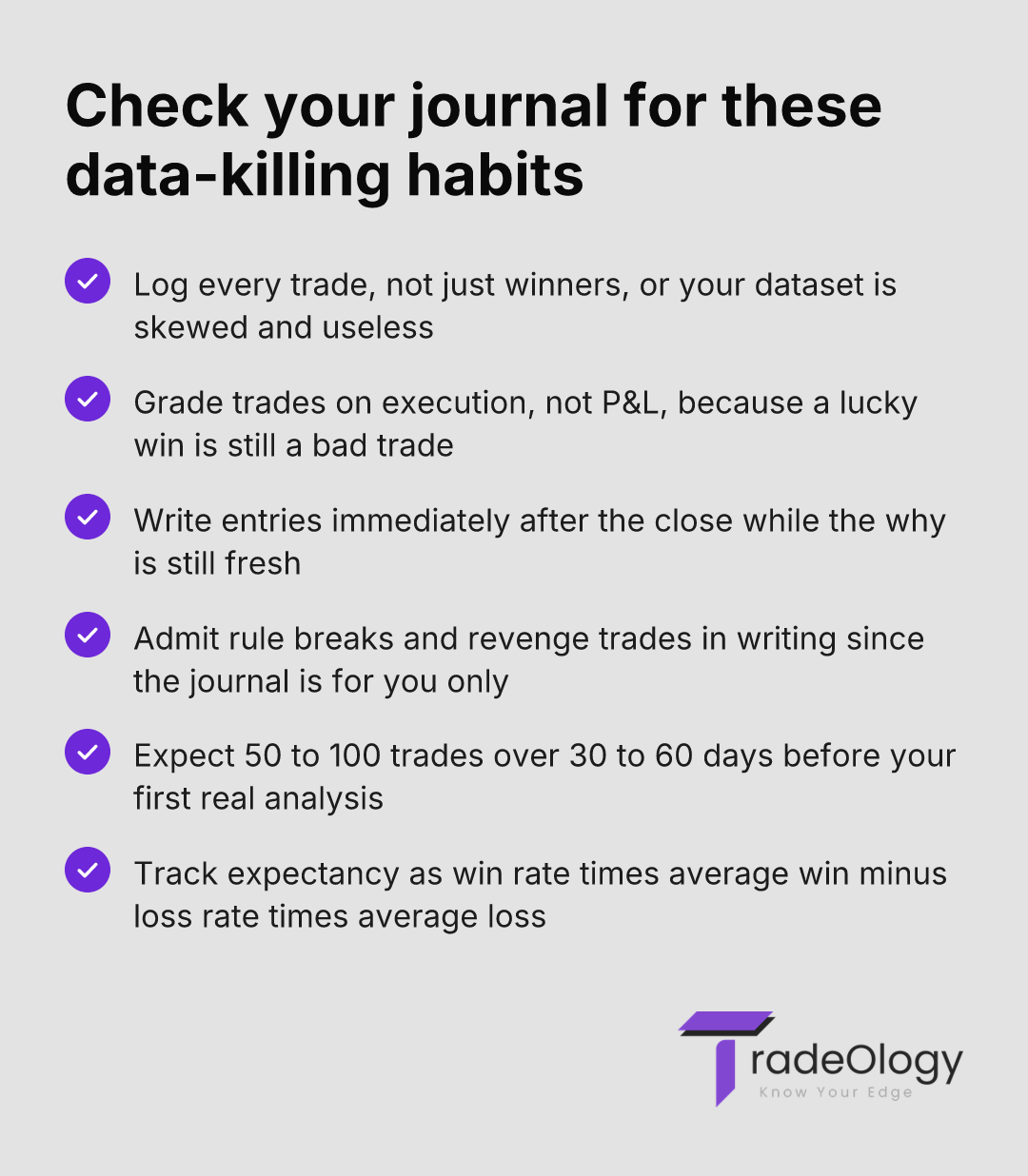
The "Good Trades Only" Journal: Many traders only log their winning trades because it feels good. This creates a completely skewed and useless dataset. Your losses teach you more than your wins, so you must log every single trade with brutal honesty.
Focusing Only on P&L: A lucky win resulting from a terrible, impulsive decision is a bad trade. A small loss resulting from a perfectly executed plan is a good trade. Your journal should help you focus on process over outcome. Grade your trades based on execution, not profitability.
Infrequent or Inconsistent Entries: If you wait until the end of the day or week to log your trades, you'll forget the crucial context—the "why" behind your decisions. Log trades immediately after they close to ensure the data is accurate.
Not Being Honest with Yourself: The journal is for your eyes only. If you broke a rule, write it down. If you revenge traded, admit it. Lying in your journal is the same as lying to your doctor about your symptoms. You’re only hurting your own chances of recovery and growth.
Data Hoarding without Review: A journal is not a data graveyard. The entire purpose is to provide insights during your review sessions. If you diligently log every trade but never schedule time to analyze the data, you’re wasting your time.
How a Dedicated Online Trading Journal Helps
This is where a professional-grade tool becomes indispensable. The primary reason traders fail at journaling is friction. It feels like a chore. An advanced online trading journal like TradeOlogy is designed to eliminate that friction and automate the analysis, solving the core problems traders face.
Instead of manually typing every entry and exit, TradeOlogy can sync with your broker to import trade history automatically. Instead of building complex spreadsheet formulas, its analytics dashboard instantly calculates your most important metrics: expectancy, win rate by setup, profit factor, performance by time of day, and more. This is one of the key benefits of journaling with a dedicated platform.
You can quickly tag trades with setups, add notes, and upload screenshots, creating a rich, filterable database of your entire trading history. This frees you up to spend your time on high-value activities—analyzing your patterns and making data-driven adjustments—rather than tedious data entry. It turns journaling from a backward-looking logbook into a forward-looking performance optimization tool.
Frequently Asked Questions (FAQ)
Is a spreadsheet good enough for a trading journal?
A spreadsheet is a great starting point and is certainly better than nothing. It forces you to manually engage with your data. However, it is labor-intensive, prone to errors, and requires significant skill to create the kind of advanced analytics needed for deep insights. A dedicated online trading journal automates trade importing and provides instant, interactive dashboards for strategy performance tracking. This saves you dozens of hours and uncovers patterns you would likely miss in a spreadsheet, making the small investment in a dedicated tool one of the highest ROI decisions a trader can make.
How soon will I see results from using a trading journal?
You will see immediate results in discipline and awareness just by formalizing your process. Within 30 to 60 days of consistent daily use, you should have enough data (typically 50-100 trades) to perform your first meaningful analysis. This is when you can start spotting real, actionable patterns. For example, you might discover that your short trades are consistently more profitable than your long trades. Lasting improvement is a direct result of the insights you gain and the rule-based changes you implement from your trading log analysis.
What is the single most important metric to track in my journal?
While P&L is the most obvious metric, it's not the most important. The single most powerful metric for evaluating strategy viability is Expectancy. Expectancy tells you what you can expect to make or lose on average, per trade, over a large series of trades. The formula is: `(Win Rate x Average Win Size) – (Loss Rate x Average Loss Size)`. A positive expectancy means your strategy is profitable over the long run, even with a low win rate. Tracking this in your trading journal shifts your focus from individual trade outcomes to the statistical edge of your system.
Conclusion: Your Foundation for a Trading Career
Trading in financial markets is one of the most competitive environments in the world. You are competing against algorithms, hedge fund quants, and seasoned professionals. Attempting to compete without tracking your own performance is like a professional athlete trying to win a championship without ever watching game tape. It’s simply not a sustainable strategy. A trading journal is your personal game tape. It provides the objective feedback loop required for deliberate practice and skill development. It is the dividing line between amateur gambling and professional, data-driven trading.
Ultimately, a detailed **trading journal** is the foundation upon which every successful trading career is built. It’s the tool that fosters discipline, reveals your behavioral flaws, validates your strategies, and provides a clear path to improvement. If you are serious about becoming a consistently profitable trader, making a commitment to diligent journaling is the most critical step you can take.