

Your "Perfect" Backtest Is a Liability
You have a strategy with a beautiful backtested equity curve. The numbers are clean. The expectancy is positive, the drawdown is manageable. You feel the familiar confidence that comes before risking real capital. Then you trade it live. The results are nothing like the spreadsheet. Slippage eats your edge. You hesitate on entries, second-guess exits, and the clean curve descends into a chaotic mess on your P&L statement. The system is bleeding money.
This is the most common point of failure for experienced traders. It is not a flaw in your understanding of risk or market structure. It is a flaw in your process. You have mistaken a calculated history lesson for a prediction of the future. True trading strategy validation is not about finding the perfect past. It is about proving a strategy is robust enough to survive the chaotic, imperfect present.
Backtesting vs. Forward Testing: You Are Asking the Wrong Question
The debate over backtesting vs. forward testing is a trap. It implies you must choose one over the other. This is incorrect. One is a historical query; the other is a live-fire drill. They are two distinct stages of a single, professional process. Treating them as a choice is why your results are unstable and your confidence is shot.
Backtesting is where you isolate a potential statistical edge. Nothing more. Its purpose is to answer one question: "Did this set of rules have a positive expectancy over a historical data set?" It is prone to data mining bias, where you endlessly tweak parameters until the past looks perfect. This creates a strategy optimized for data that will never repeat, not a robust trading system for the future.
Forward testing, or incubation, is where you test the human factor and real-world execution. Can you execute the rules under live conditions without emotional interference? Do fills, slippage, and spread changes destroy the theoretical edge? A backtest never answers these questions. Your P&L, however, does.
A Practical Framework for Real Trading Strategy Validation
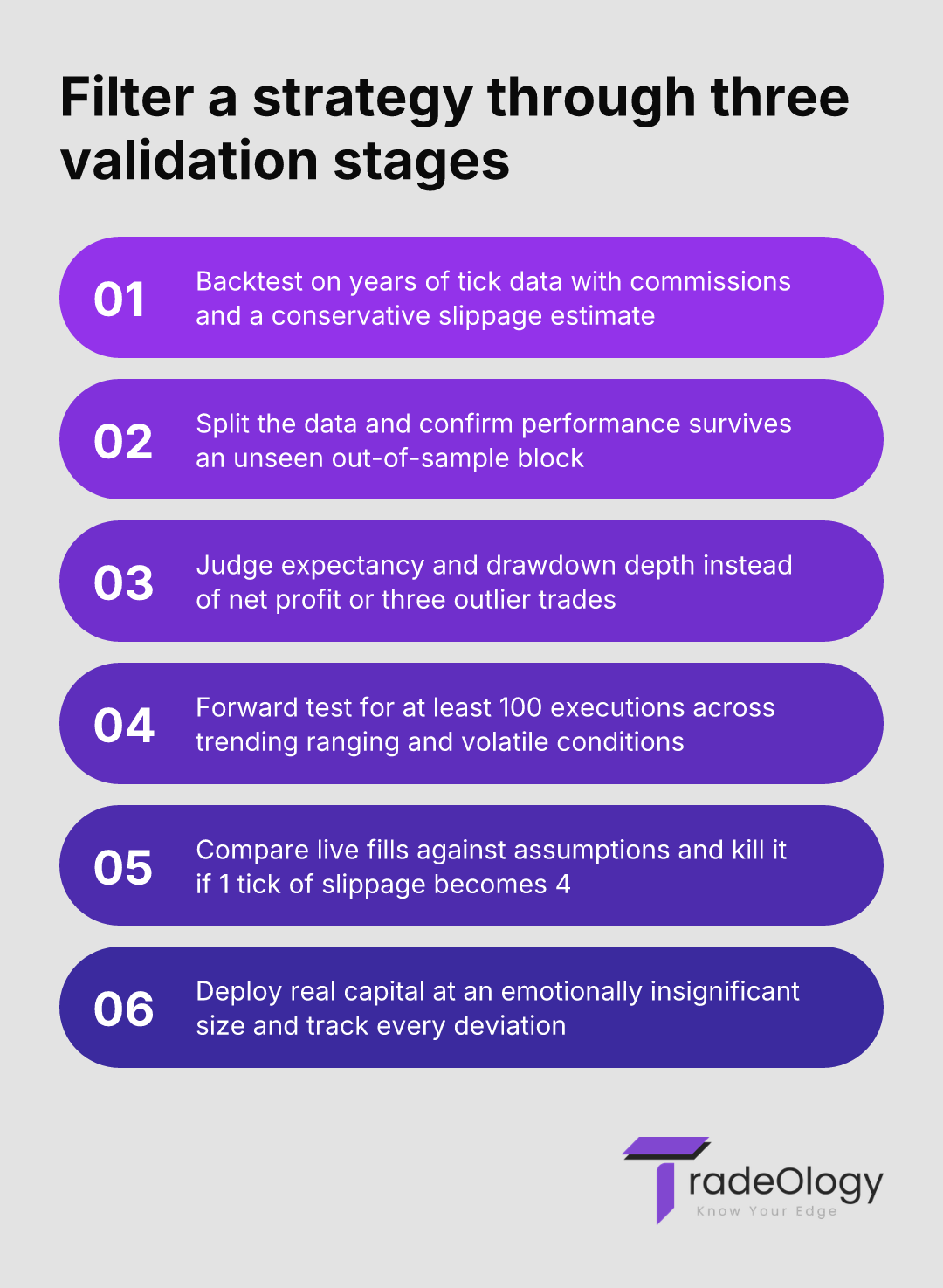
Stop looking for a single passing grade. A professional validation process is a multi-stage filter. A strategy must pass every stage before it earns the right to significant capital.
Stage 1: Rigorous Backtesting (The Historical Search)
The goal here is not to create a beautiful equity curve. The goal is to kill the strategy. Your objective is to find out if the core concept has any statistical merit at all.
Data Integrity: Use a large data sample. For a day trading strategy, this means years of tick data, not just a few months. Account for commissions, and apply a conservative slippage estimate to every trade.
In-Sample vs. Out-of-Sample: Build your strategy on one block of data (in-sample) and test it on a completely separate, unseen block (out-of-sample). If the performance collapses on the unseen data, your strategy is not robust. It was curve-fit.
Focus on Core Metrics: Do not fixate on net profit. Analyze the trading expectancy, the depth and duration of drawdowns, and the distribution of returns. Is the profit coming from three huge outliers or a consistent edge? Read our guide on how to properly evaluate a trading strategy for a deeper dive.
Stage 2: Forward Testing (The Incubation Period)
Most traders skip this. This is exactly where the damage starts. Forward testing on a paper or micro-sized account is not about making money. It is about stress-testing the *process* in a live environment.
Trade Count, Not Time: Your goal is a statistically relevant number of trades. Aim for at least 100 executions. A few weeks is not enough. You need to see the strategy perform across different market conditions.
Execution Analysis: This is a test of you as much as the system. Are you entering and exiting according to the rules? Are you hesitating? Your trading journal is your most crucial tool here. Be brutally honest.
Reality Check: Do the live fills, spreads, and slippage align with your backtest assumptions? If your backtest assumed 1 tick of slippage but you are averaging 4, the strategy is likely dead.
Stage 3: Live Validation (Limited Risk Deployment)
Only after a strategy passes forward testing does it earn the right to touch real, meaningful capital. This is not the time to go all-in. This is the final stage of validation.
Start Small: Trade the strategy with a position size that is emotionally insignificant. The goal is to validate the process under the pressure of real financial outcomes without letting that pressure derail your execution.
Track Everything: Every execution, every emotional mistake, every deviation from the plan. This data is the final proof. Your results here—not the backtest—determine if you increase size.
A Real-World Example: Where the Process Breaks
Consider a mean-reversion strategy on oil futures. A trader runs a backtest on 2 years of data. The results look incredible: a 65% win rate and a smooth 3.0 R/R. The trader, eager for profits in the volatile 2026 market, skips forward testing and goes live with a $50,000 account, risking $500 per trade.
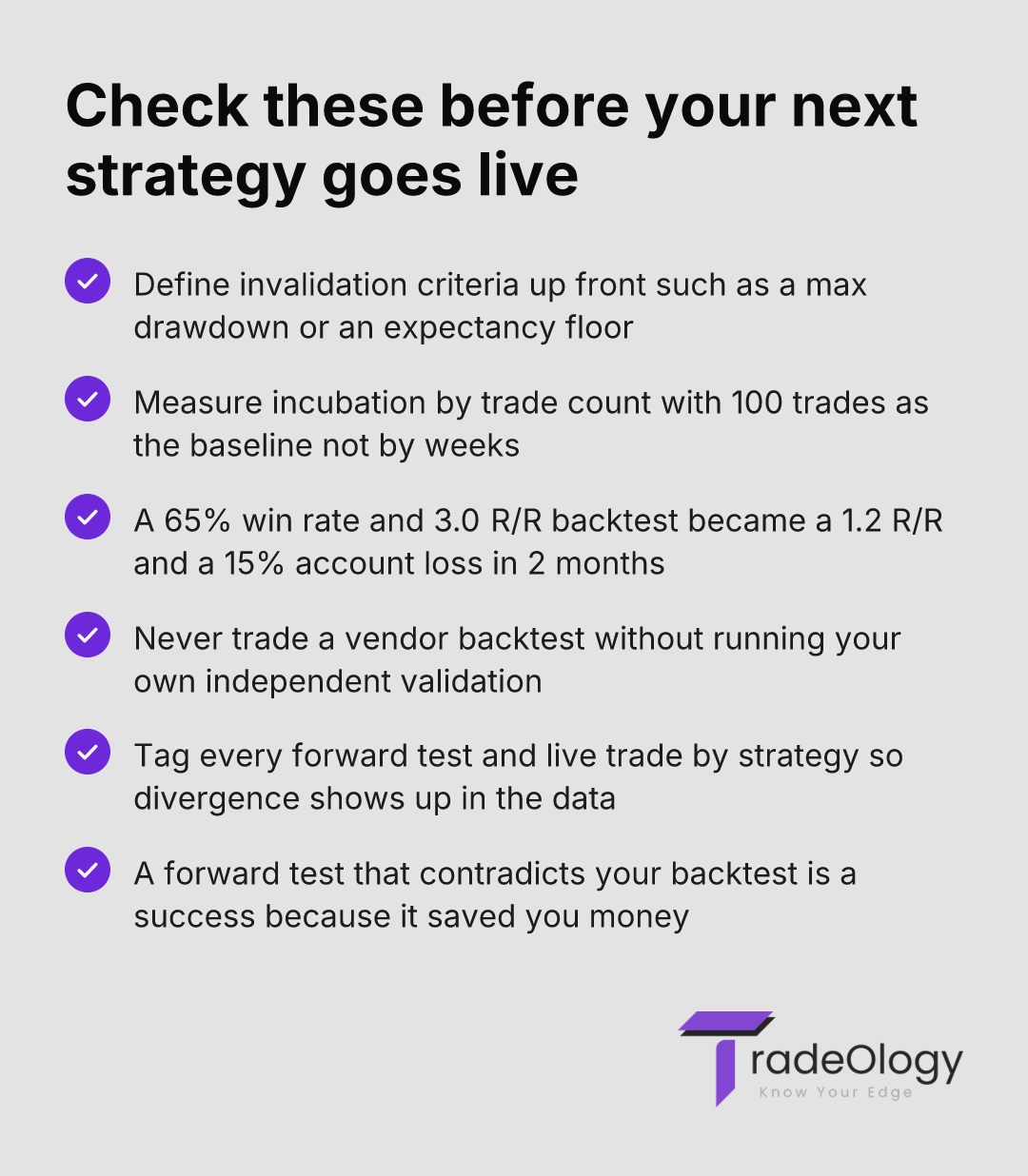
The results are disastrous. The backtest did not account for the massive slippage during inventory reports. The strategy requires holding through volatility, but the trader, seeing real money evaporate, cuts winning trades early, crushing the R/R down to 1.2. They hesitate on entries after a string of three losses, missing the single trade that would have made the month profitable. After two months, the account is down 15% and the trader abandons the "failed" system.
The system did not fail. The validation process failed. Forward testing would have exposed the slippage issue and, more importantly, the trader's own inability to execute the system with discipline. The loss was preventable.
Common Mistakes in Strategy Validation
Trusting Vendor Backtests: Never, ever trust a backtest provided by someone selling a system. Run your own independent validation.
Ignoring the Execution: You think you are testing a system, but you are really testing your ability to execute it. If you cannot follow the rules, the system's theoretical edge is irrelevant.
Confusing Incubation with Live Trading: Forward testing is for data collection. Live trading is for profit generation. Do not mix the two. A system in incubation should not be traded with full size.
Having No Invalidation Criteria: Before you start, define what failure looks like. A maximum drawdown? A drop in expectancy below a certain threshold? If you do not define it, you will rationalize losses until the account is blown.
How TradeOlogy Forces a Better Process
A spreadsheet cannot fix this. A clean dashboard does not fix a bad process. Better review does. TradeOlogy is built for the critical stages of forward testing and live validation.
Stop guessing if you are following the rules. During your forward test, tag every trade with the strategy name. When you go live, do the same. The platform’s analytics will show you the cold, hard data: Are your real-world metrics matching the backtest? Where are they diverging?
Use our advanced trading analytics to filter P&L by strategy, instrument, and time of day. You will see precisely where the strategy leaks money. Is it slippage? Is it your discipline on Fridays? The data will prove it. This is not about motivation; it is about diagnostics. The trade review process is what separates break-even hobbyists from profitable traders.
Frequently Asked Questions
How long should I forward test a strategy?
You measure by trade count, not time. You need a sample size large enough to be statistically relevant. A minimum of 100 trades is a solid baseline. It must be long enough to cover various market conditions—trending, ranging, and volatile. If the process feels boring and mechanical by the end, you have done it right.
What if my forward test results do not match my backtest?
This is a successful test. It has just saved you money. The mismatch proves one of two things: either the backtest was flawed (curve-fit, wrong assumptions on costs) or you are unable to execute the system as designed. Both are critical findings. Now you must diagnose the cause. Is it the system, or is it the operator?
Is a good backtest completely useless then?
No. A rigorous backtest is a useful first filter. It helps you discard bad ideas quickly without wasting time on forward testing. It is for idea generation and hypothesis testing. It is just not a performance guarantee. Think of it as a resume; it gets you the interview, but the interview (forward testing and live trading) determines if you get the job.
Backtesting Proves Nothing. Live Data Is Everything.
The argument is not about backtesting vs. forward testing. It is about a disciplined, professional validation workflow versus impatient gambling. Amateurs chase perfect-looking backtests. Professionals build a robust process to see if a strategy survives first contact with the live market.
Your goal is not to find a system that *would have* worked. It is to find a system that *will* work, and that you *can* execute. Stop hiding behind your spreadsheets. The ultimate form of trading strategy validation is not found in historical data; it is printed on your P&L statement.