

Your Weekly P&L Is a Useless Metric
You ended the week up 2%. You think the week was a success. You are wrong. Your P&L is the most deceptive metric in your entire trading dashboard. It tells you what happened, but it tells you nothing about why. And it says nothing about whether it will happen again.
A positive week full of bad-process trades is more dangerous than a negative week with clean execution. One builds delusions; the other builds data. Your refusal to see the difference is the leak in your system. This is not about feeling good. This is about building a process that is not dependent on luck. A professional trade review process is not a casual flip through your journal. It is a forensic examination of your decisions.
Most traders treat their review like a chore. They scan their losses, feel a pang of regret, and promise to “be more disciplined next week.” That is not a review. It is a wasted opportunity. It is the reason your equity curve looks like a dysfunctional rollercoaster.
You Think You Are Reviewing Trades. You Are Judging Outcomes.
Here is where traders fool themselves. They open their journal and filter for red trades. They look at a loss and conclude the setup was bad, the market was choppy, or they made a mistake.
That is not the real problem. This is.
They filter for green trades. They look at a 3R winner and see themselves as a genius. They screenshot the entry and validate their bias, completely ignoring the fact that they violated three of their own rules to get it. They entered too early, used too much size, and moved their stop. The market bailed them out.
This is why your results are unstable. You are reinforcing bad habits because the outcome was positive. Your trade review process is contaminated by outcome bias. You are not analyzing your decisions; you are celebrating or regretting random results. You must separate the quality of your decision from the quality of the outcome. A good trade can lose money. A bad trade can make money. Until you accept this, you will never achieve consistent performance.
What Actually Matters: Conformance Score
Stop rating your trades by P&L. Start rating them with a Conformance Score. This is a simple, binary rating for every rule in your trading plan. Did you follow the rule? Yes or No. 1 or 0.
A trading plan is not a vague set of guidelines. It is a checklist. Your pre-trade checklist should have 5-10 hard rules. Your execution checklist and trade management rules must be just as rigid.
For every trade, you should be able to score your conformance:
Entry Signal: Was the entry criteria met exactly as defined in the plan? (Yes/No)
Position Sizing: Did you use the correct size based on your risk model? (Yes/No)
Stop Loss: Was the stop placed exactly where the plan dictated upon entry? (Yes/No)
Trade Management: Did you move your stop or take profits only when your rules permitted? (Yes/No)
Emotional State: Was the trade executed without emotional interference (FOMO, revenge trading)? (Yes/No)
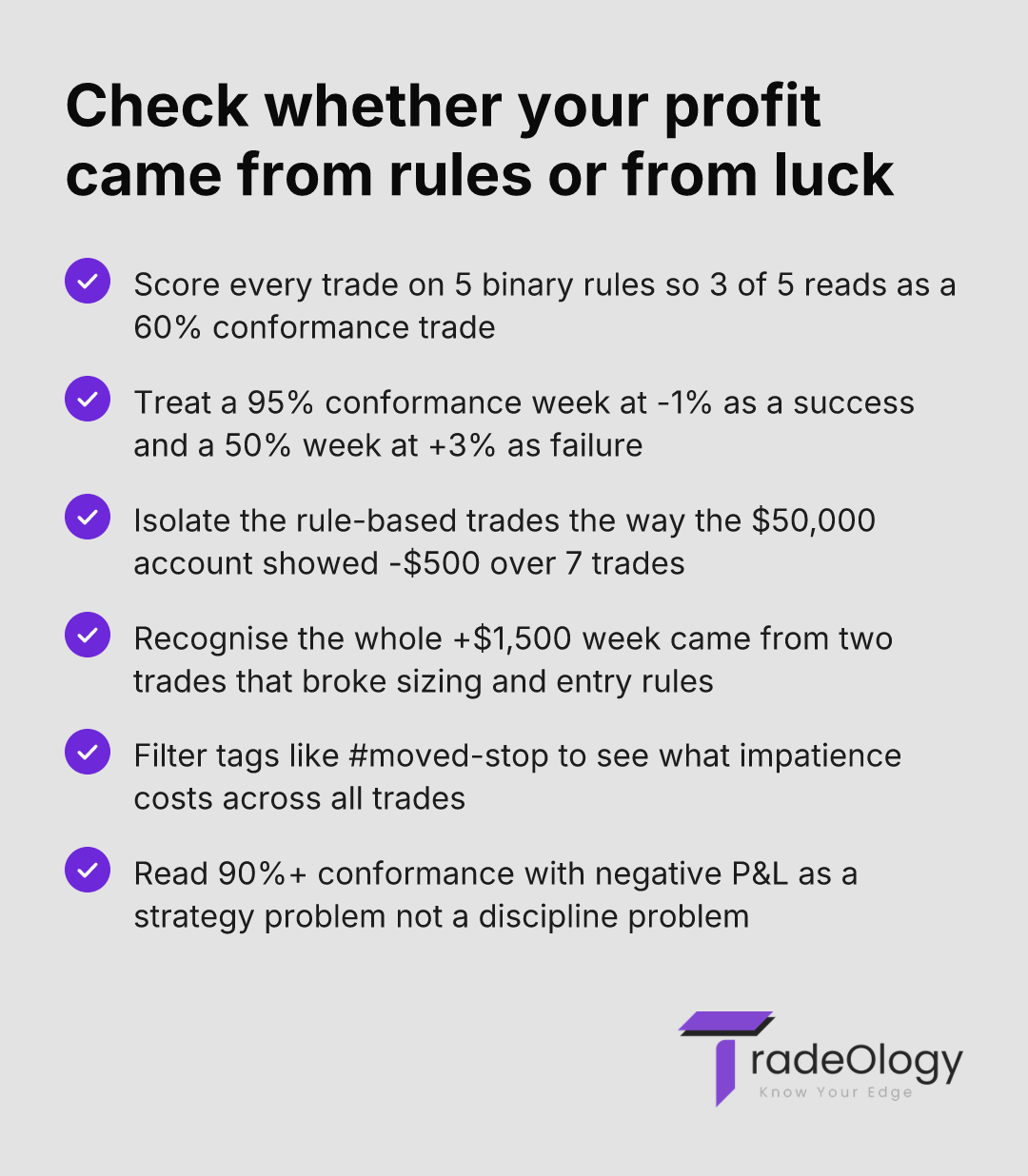
A trade with 5/5 "Yes" answers is a 100% conformance trade. A trade with 3/5 is a 60% conformance trade. P&L is irrelevant to this score. Your goal is not to be profitable on every trade. Your goal is to achieve 100% conformance on every trade. Profitability is the byproduct of discipline, not the goal itself.
Your weekly review should not be about P&L. It should be about your average Conformance Score. A week with a 95% Conformance Score and a -1% return is a massive success. It proves your system works and you can follow it. A week with a 50% Conformance Score and a +3% return is a failure. You got lucky, and winter is coming. Find out what is causing the conformance gap with a real trade review process.
A Weekly Review That Does Not Waste Your Time
Most traders stop here. They have a score. They feel they have done the work. That is exactly where the damage starts. The score is not the analysis. The score tells you where to look.
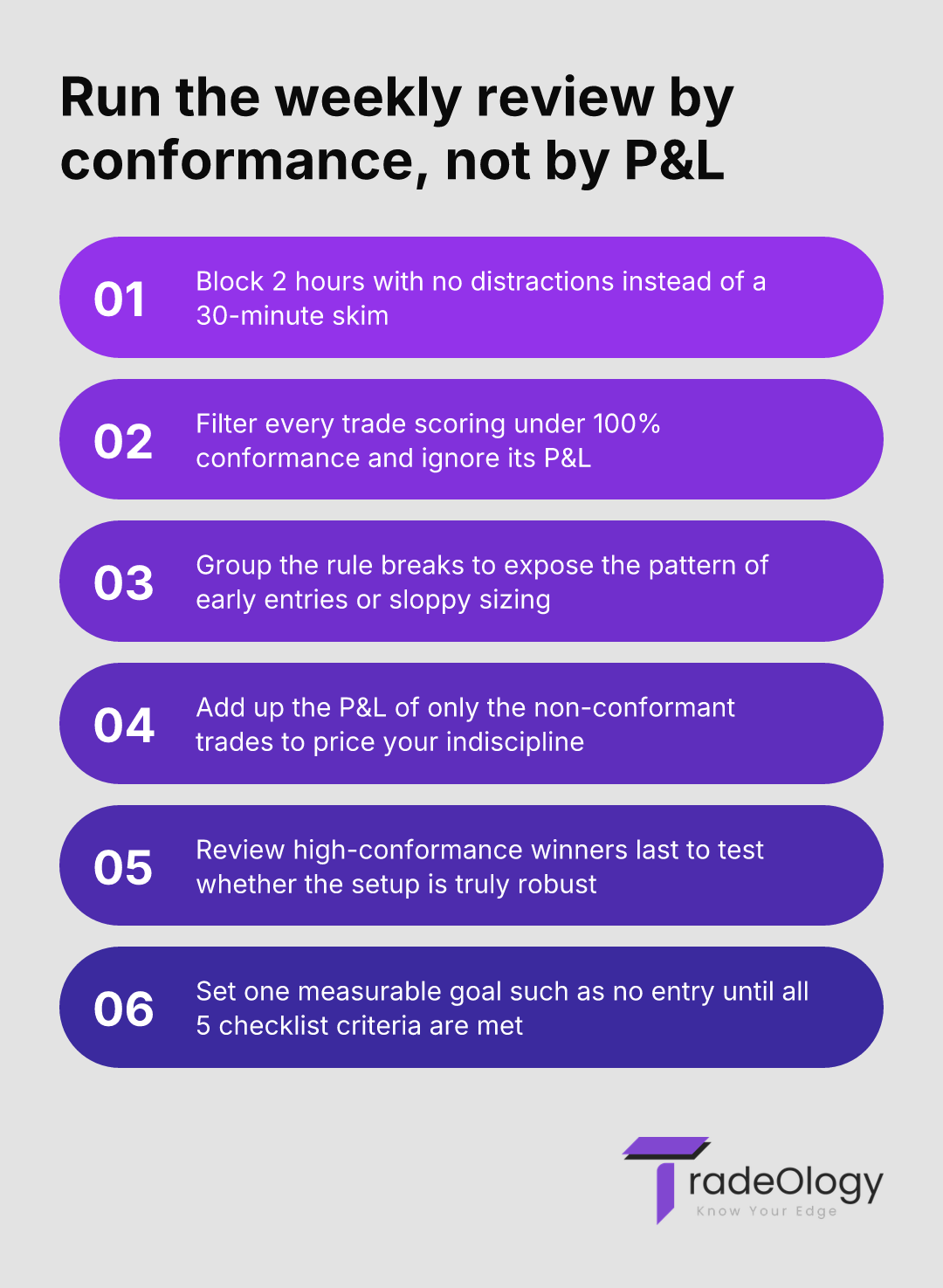
This is not a 30-minute task. This is a 2-hour, focused session. No distractions. No excuses.
Filter by Conformance, Not P&L: Start by looking at all trades with less than 100% conformance. Isolate every trade where you broke a rule. The P&L of these trades does not matter. The fact you broke a rule is all that matters.
Identify the Pattern: Where is the deviation? Are you consistently entering early? Is your position sizing sloppy when you feel confident? Are you exiting profitable trades too soon, wrecking your expectancy? Group the low-conformance trades by the rule you broke. You will find the pattern immediately.
Quantify the Damage: Calculate the total P&L of only the non-conformant trades. This number is the cost of your indiscipline. Your journal proves it. Stare at that number. This is what you are paying the market to teach you a lesson you keep ignoring. For a deeper look at the data, see this breakdown on performance attribution.
Analyze Winning Trades Last: Now, review your high-conformance winning trades. Did they work because the setup is robust or because of a random market spike? This is where you validate your strategy. See if your edge is actually playing out as expected according to your trading strategy evaluation.
Create One Actionable Goal: Do not end your review with a vague promise to "be better." Create one single, measurable goal for the next week. Not "I will be more patient." But "I will not enter a single trade until all five of my entry checklist criteria are met."
Real-World Example: How a Winning Week Hides a Major Flaw
Let's look at a trader with a $50,000 account, risking $500 per trade (1%).
The Superficial Review:
Total Trades: 10
Wins: 5, Losses: 5 (50% Win Rate)
Total Profit: +$1,500 (+3% account gain)
Conclusion: "Good week. The strategy is working."
The Real Trade Review Process:
The trader uses a Conformance Score and finds this:
Trades 1-7 (100% Conformance): 3 Wins (+3R), 4 Losses (-4R). P&L: -$500. Average R/R executed was clean.
Trade 8 (60% Conformance): The trader doubled their position size impulsively on a "gut feeling." The market ran and they banked +4R instead of +2R. They broke their sizing rule. P&L: +$2,000.
Trade 9 (80% Conformance): The trader entered early, breaking an entry rule. They got a lucky fill and a 2R win. P&L: +$1,000.
Trade 10 (100% Conformance): 1R Loss. P&L: -$500.
The Correct Conclusion:
The trader's actual system is underperforming. The core, rule-based strategy produced a -$500 loss over 7 trades. The entire week's profit, and then some, came from two trades where rules were broken. The trader did not have a good week. They had a lucky week. Their process has a hole. This is why their results are unstable. Relying on luck is not a strategy; it is a path to blowing an account.
How TradeOlogy Forces a Real Review
You think you fixed this. You did not. You promise to be disciplined, but manually tagging and scoring every trade is tedious. After a long trading day in 2026, you will get lazy. You will skip it.
This is where your system breaks. Not in the market, but at your desk at 8 PM.
A tool like TradeOlogy removes the friction. It automates the tedious parts of the trade review process so you can focus on analysis, not data entry.
Automated Tagging: Instead of manually writing down which rule you broke, you create custom tags (#early-entry, #bad-sizing, #moved-stop). Click a button. The data is logged. Flawlessly.
Powerful Filtering: Do not just filter by P&L. Filter by your custom tags. With one click, see the total P&L of all your "#moved-stop" trades. See how much money your impatience is costing you. The data is clear.
Objective Metrics: TradeOlogy automatically calculates metrics like trading expectancy and profit factor based on your filtered trades. You can see the expectancy of your 100% conformance trades versus your low-conformance trades. This is not an opinion; it is math. You are bleeding money here and your journal proves it. A clean dashboard does not fix bad process. Better review does.
FAQ for the Serious Trader
How often should I conduct this deep review?
A full, forensic weekly review is mandatory. A quick post-trade analysis with conformance scoring should happen every single day. If you don't have 15 minutes to review your trades daily, you don't have what it takes to trade professionally.
My journal shows I am following my rules, but I am still losing money. What now?
This is a good problem to have. It is the only real problem. If your conformance is high (90%+) for a month and your P&L is negative, you do not have a discipline problem. You have a strategy problem. The market conditions in 2026 may have shifted, or your edge might be weaker than you thought. Now you can work on adjusting the strategy itself, knowing your execution is solid. You have clean data to work with. Before, you had noise.
How detailed does my trading checklist need to be?
Detailed enough that another trader could execute your plan with zero ambiguity. "Enter on a breakout" is not a rule. "Enter with a 5-minute candle close above the 2-hour high on a volume spike of at least 150% of the 20-period average" is a rule.
Stop Looking for a New Strategy
Your strategy is not the problem. Your execution is. The gap between your plan and your actions is costing you more than any losing streak. You already know what to do. You wrote the rules in your trading plan. The market is not your enemy; your own undisciplined decisions are. A bulletproof trade review process is not optional. It is the only path to identifying your flaws and systematically eliminating them. Stop lying to yourself with P&L and start holding your execution to a higher standard.