


FREE TRADING ACADEMY
Learn to trade with our free trading academy
A step-by-step path from your first lesson to your first reviewed trade. Five steps, each linked to the lessons that teach it, in the order that keeps you from learning the expensive way.
No account, no email wall, no ads. Not financial advice.
THE PATH
Five steps, in the order that matters
Most beginners start with strategies and skip risk. This order puts risk in step three, before you pick a style.
UNDERSTAND THE MARKET
Learn what you are actually trading
How markets work, what stocks, options and futures are, and which trading style fits your time and money.
READ A CHART
Learn to read price
Candles, support and resistance, trends and breakouts: the building blocks every setup is made of.
MANAGE RISK
Learn risk before you learn setups
How much to risk, where the stop goes and how big to trade. This is what keeps an account alive long enough to learn.
PICK A STYLE
Go deep on one way of trading
Day trading, swing trading or options. Pick the one that fits your schedule and learn its rules and setups.
PRACTICE AND REVIEW
Practice, then keep score
Run a pre-trade checklist, keep a journal and review it weekly. The journal is where you find out what actually works for you.
STEP 04, IN DETAIL
Day trading, swing trading or options?
| Day trading | Swing trading | Options trading | |
|---|---|---|---|
| You hold a trade | Minutes to hours, closed by the end of the day | Days to weeks | Same day to months. Most are closed before the contract expires |
| Time it takes | Market hours, most active in the first two hours | About 5 to 7 hours a week, works with a day job | Depends on the strategy |
| Lessons | 13 | 13 | 10 |
| Start here | Day Trading for Beginners: The Honest Starter Guide | Swing Trading for Beginners: The Honest Starter Guide | Options Contract Mechanics |
Not sure? Read Day Trading vs Swing Trading first.
EVERY COURSE
All 7 courses, free
- Intro to TradingFundamentals, markets, and how trades actually work.8 lessons
- Technical AnalysisCandlesticks, chart patterns, and price action.10 lessons
- Risk & PsychologyPosition sizing, risk control, and the trader's mindset.16 lessons
- Options TradingContracts, Greeks, volatility, and strategies that go beyond directional bets.10 lessons
- Day TradingIntraday strategies, US margin rules, and the daily routine that makes day trading sustainable.13 lessons
- Swing TradingMulti-day setups, the daily-chart playbook, and the ~5-hour-a-week routine.13 lessons
- Order FlowMarket structure, liquidity, and smart money concepts.9 lessons
FREE CALCULATORS
The math every trader uses
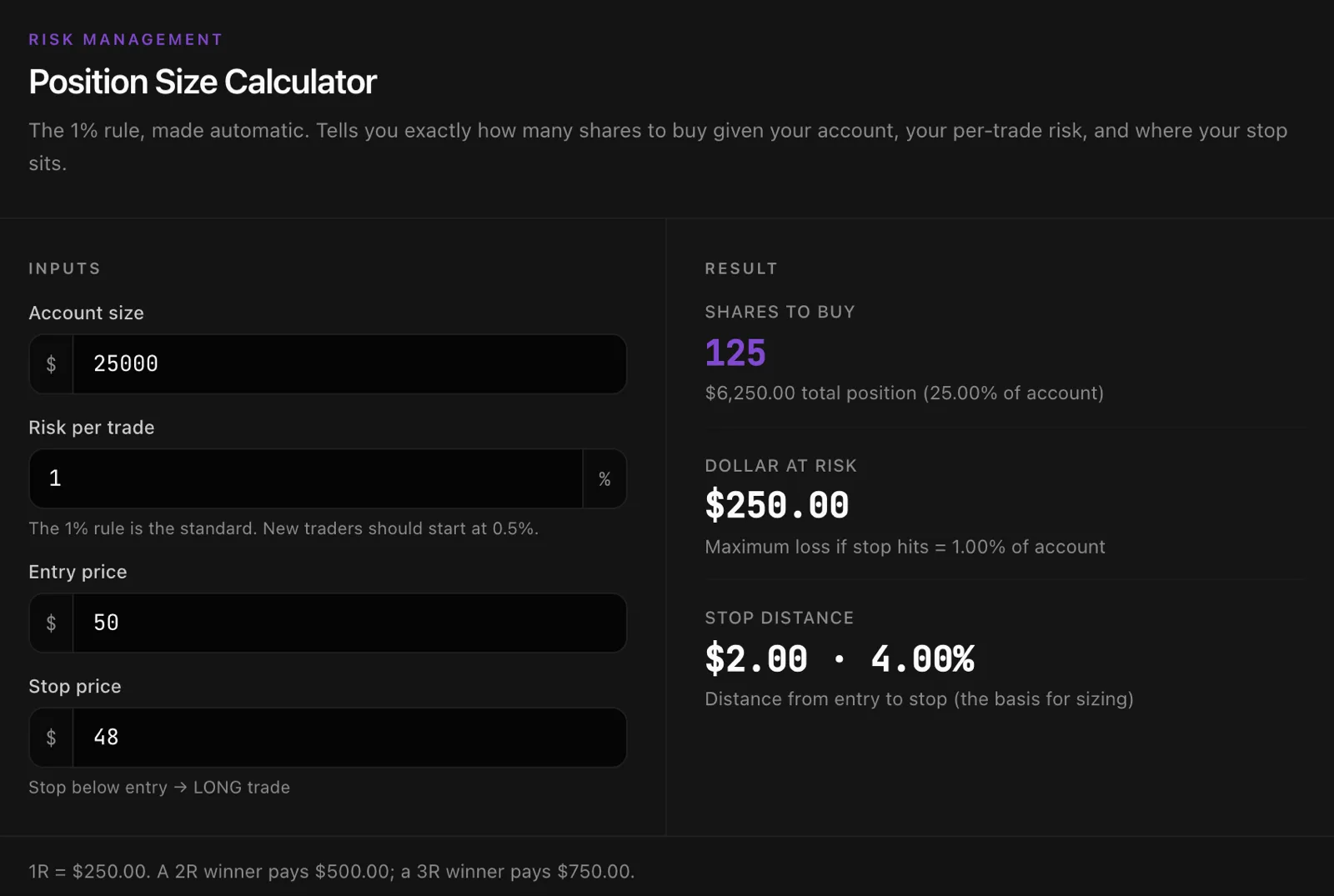
- Position sizeHow many shares or contracts to buy for your account, risk and stop.
- Risk-reward ratioWhether a setup pays enough for the risk you are taking.
- R-multipleAny trade result in R units, so wins and losses compare fairly.
- ExpectancyWhat one trade is worth on average, and what 100 of them add up to.
- Profit factorGross wins against gross losses: is the edge real?
- Kelly criterionThe most you should ever risk per trade, and why to risk less.
- Drawdown recoveryThe gain needed to get back from any loss. A 50% loss needs 100%.
- Options P/LProfit, loss and breakeven at expiration for a call or put.
REFERENCE
Look it up when you need it
- Trading glossary132 trading terms in plain English, each linked to its lesson.
- Candlestick patterns30 candle patterns with the entry, stop and confirmation for each.
- Chart patternsHead and shoulders, flags, triangles and how to trade them.
- IndicatorsVWAP, RSI, ADX and more: how to use them, not just add them.
- Common mistakesThe errors that cost new traders the most, and the fix for each.
- Trading journal templateA free template to start recording trades today.
FROM LEARNING TO DOING
Reading is step one. Your journal is where it sticks.
Read the lesson
Free, written lessons with charts built for each concept. No account, no email wall, no ads.
Open the AcademyTry it risk-free
On Pro Advanced, rewind a stock, ETF or index future to a past date and trade it forward in the Trade Simulator.
See the simulatorSee if it works for you
Log your real trades free, or auto-sync them on Pro, and let your journal show which habits make money.
See the journalLearning to trade, answered
Yes. TradeOlogy Academy is a free trading academy: every one of its 80 lessons, the calculators and the glossary are free to read with no account and no email wall. You only need a TradeOlogy account to journal your own trades (free) or practice in the Trade Simulator (Pro Advanced).
Start with What Is Trading in the Intro to Trading track, then Technical Analysis and Risk & Psychology. After that, pick the style that fits your schedule: day trading, swing trading or options.
Reading the whole Academy takes about 21 hours. Learning to trade well takes longer: most traders should spend 30 to 60 days reading and paper trading before funding a real account.
Stocks, options and futures. The journal itself supports stocks, options, futures, and crypto.
No. The Academy is educational. It explains how markets and trading tools work; it never tells you what to buy or sell.
Start with lesson 1. It takes 6 minutes.
Read the first lesson free, then open a free journal to record your trades as you learn.