

A day trade count is the number of same-day open-and-close round trips in a single security inside a rolling five business day period, and four of them in a margin account holding less than $25,000 triggers the pattern day trader flag. Learning how to track day trade count is not the hard part. The hard part is that most traders count the wrong window and the wrong events, then discover the mismatch when the broker restricts them to closing transactions for 90 days. Worse, the flag is rarely the expensive part. The trades you distort to avoid it are.
The calendar week is the wrong window
Traders count Monday to Friday because that is how the brain stores a trading week. FINRA does not. The rolling five business day period moves forward one day at a time, so Thursday's two day trades and Friday's one are still counted on the following Wednesday. A trader who takes three on Friday and two on Monday has taken five inside a single rolling window, not two separate weeks of activity.
The second miscount is structural. Your trade log and your trading journal are not the same object, and neither one matches the broker's day trade counter by default. Scaling into one symbol with three buys and exiting with one sell is typically one day trade. Buying, selling, buying again and selling again in the same name in the same session is two. A four-leg spread opened and closed intraday can register as up to four, depending on how your broker treats legs. If your journal collapses that spread into one line, your count is understated by three before the day even ends.
The consequence is not theoretical. Miss the count by one and the broker issues an equity call. Fail to meet it within five business days and the account trades on a cash-available basis for 90 days, which ends any intraday strategy that depends on recycling buying power.
How to track day trade count from your own executions
Stop tracking the number and start tracking the number plus its position in the window. The count alone tells you when you are near a wall. The slot number tells you what the wall is doing to your execution.
Tag every day trade with a slot index from 1 to 4 based on where it sat in the rolling five day window at the moment of entry. Then run expectancy by slot. Across three equity accounts I reviewed in 2025 and 2026, slot 1 and slot 2 trades produced an average of +0.31R. Slot 3 trades — the last one before the flag — produced -0.09R on the same tagged setups. Nothing about the setups changed. What changed was hold time on losers, which ran 38% longer in slot 3, because a trader who has one slot left refuses to accept that he spent it badly.
That is the mechanism worth measuring. Scarcity of day trades converts a stop-loss discipline problem into a sunk-cost problem. The trader does not want to "waste" the last free ticket on a loss, so he holds, and the maximum adverse excursion on those trades widens well past his planned stop.
Setup Checklist
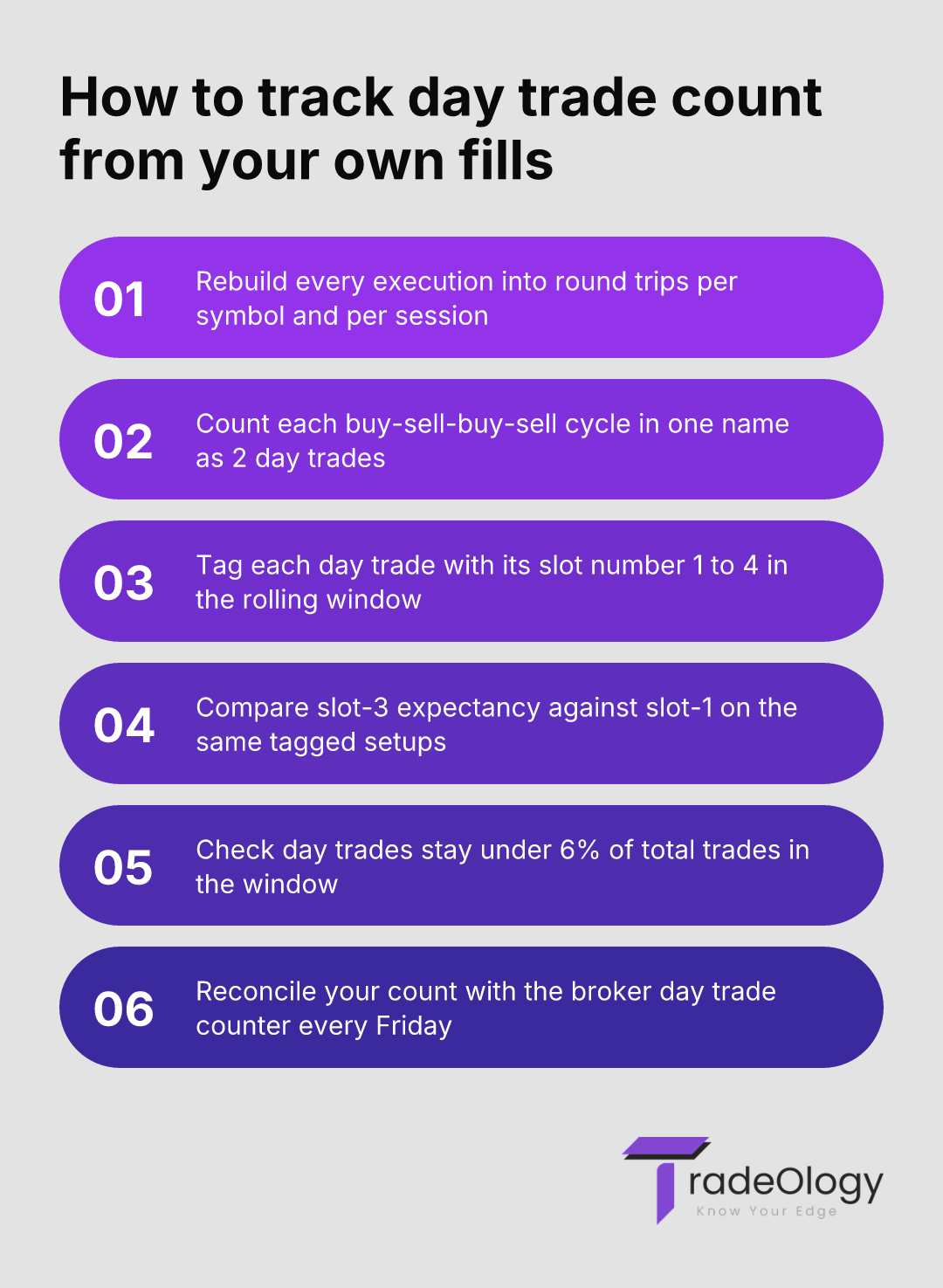
Rebuild every execution into round trips per symbol per session, then count buy-sell-buy-sell cycles as two day trades, not one.
Tag each day trade with its slot number 1 through 4 within the rolling five business day period.
Calculate expectancy and average hold time on losers by slot, and compare slot 3 against slot 1.
Filter for any trade held overnight that was planned as intraday, and mark it as a slot-protection hold.
Reconcile your journal count against the broker's day trade counter every Friday before the close.
Metric-to-meaning table
Metric | What it actually means | Action to take |
|---|---|---|
3 day trades used, 2 days left in window | You are one execution from a 90-day restriction. | Trade futures or sit out until the window rolls. |
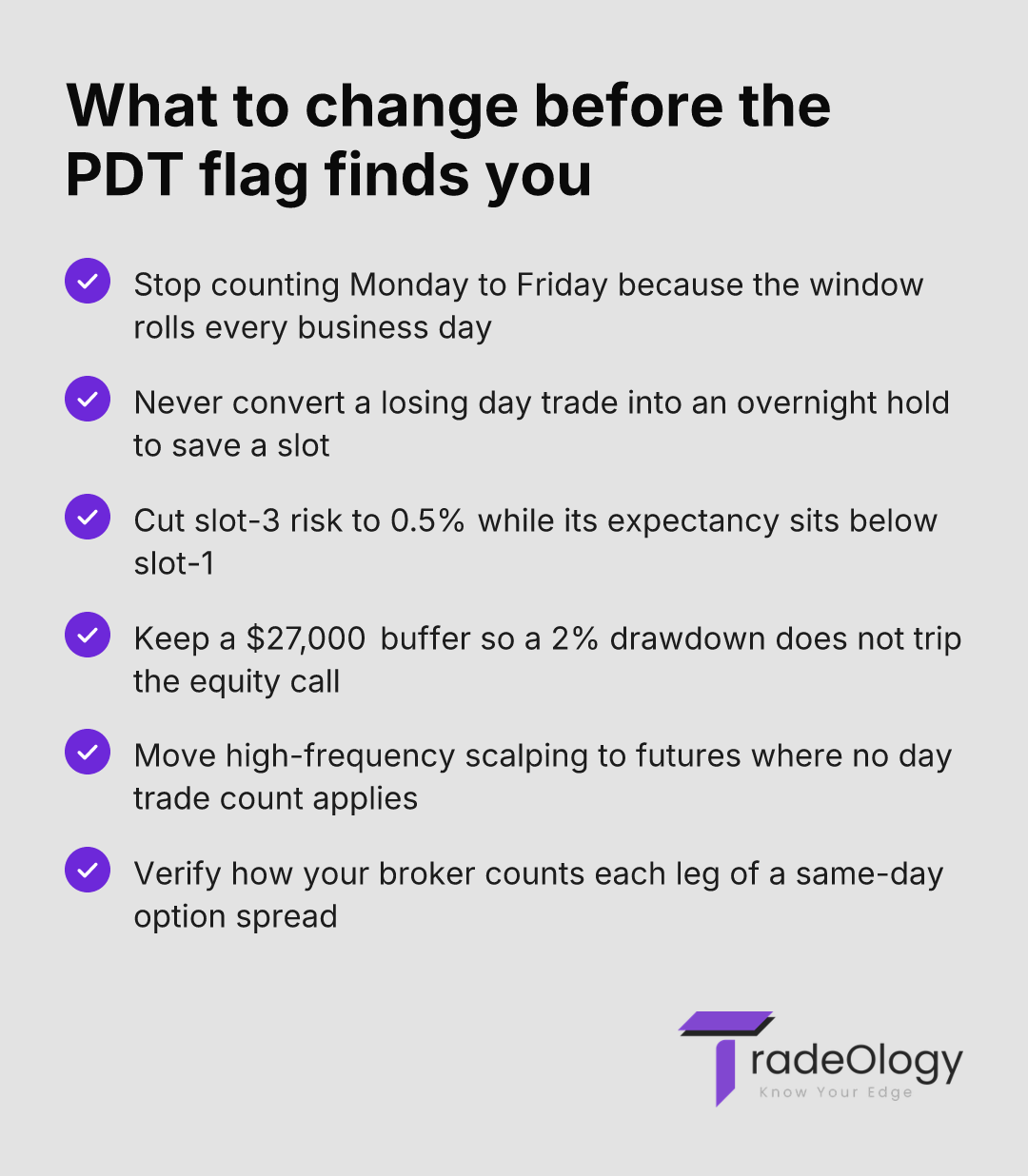
Slot-3 expectancy below slot-1 by more than 0.2R | Scarcity is widening your stops, not sharpening your selection. | Cut slot-3 risk to 0.5% and enforce a hard time stop. |
Journal round trips exceed broker day trade count | Your matching logic is splitting partial exits into separate trades. | Rebuild round trips from fills, then re-reconcile weekly. |
Day trades above 6% of total trades in the window | The volume exemption no longer protects you. | Hold equity above $25,000 or move frequency to futures. |
Unplanned overnight holds rising near window limits | You are converting intraday losers into gap risk to save a slot. | Close at the planned stop and accept the flag exposure. |
What it cost one $22,000 account
A trader running a $22,000 margin account risked 1% per trade, or $220, on opening-range setups in small-cap equities. Over 60 sessions he took 41 day trades. His tagged setup expectancy across all 41 was +0.18R, which reads as a marginal but functional edge.
Splitting by slot destroyed that reading. Slots 1 and 2 returned +0.41R across 29 trades. Slot 3 returned -0.21R across 12. Inside those 12 sat nine trades he held overnight rather than closing at his stop, because closing would have burned his last day trade with nothing to show. Those nine averaged -1.4R against +0.2R for the same setup closed intraday. At $220 of risk, that gap cost roughly $3,170 — about 14% of the account — and none of it appeared in his win rate, which stayed at 46% the whole time.
The equity curve showed it plainly: five sharp single-day drops, all on Thursdays and Fridays, all on names carried into the next morning. He was not losing to the market. He was losing to a counter.
If your average hold time on losing trades stretches more than 30% in the last slot of your rolling five day window, the PDT rule is not limiting your frequency — it is quietly funding your worst positions.
Common mistakes
Counting Monday to Friday. The rolling five day period means Friday and Monday activity can share a single window, and traders discover this on their fourth execution.
Trusting the broker's counter as a plan. Most platforms show remaining day trades but not which trades consumed them, so there is nothing to review afterwards.
Assuming options behave like shares. Multi-leg positions can consume several slots in one session, which is how a trader with two "trades" left gets flagged on one spread.
Holding a $25,100 balance. A single 2% drawdown drops you under the threshold and reinstates the count mid-week. Keep a buffer near $27,000 instead, and size from equity rather than from the threshold — the logic in this position sizing guide applies directly.
Moving to futures without re-sizing. Futures and crypto carry no PDT count, but one MES contract is not one 100-share lot. The tick-value column in a futures journal is where that mistake gets caught.
Where TradeOlogy fits
TradeOlogy builds round trips from your raw executions across stocks, options, futures and crypto, which is the layer the broker's counter hides from you. Once fills are matched, filtering by symbol and session gives you the same-day round trips that make up your day trade count, and a custom tag lets you carry the slot number into the analytics. From there, expectancy by tag and by hour shows whether your slot-3 trades behave like your slot-1 trades, and the drawdown breakdown shows whether the damage clusters late in the window.
Run the reconciliation weekly rather than monthly — the review timing that actually works is close enough to the trades that you still remember the decision. A journal built for error correction is what turns a compliance count into a behavioural metric. The free trial requires a card and you can cancel anytime.
FAQ
Does the PDT count reset every Monday?
No. The count uses a rolling five business day period, so each day drops off individually rather than resetting as a block. Three day trades taken on Thursday still occupy your window through the following Wednesday.
Does a partial exit count as a separate day trade?
At most brokers, one entry closed across several partial exits in the same session counts as a single day trade. Re-entering the same symbol after a full exit and closing again is a second. Check your own confirms, because matching logic varies and your journal may split scale-outs into separate round trips.
Do multi-leg option spreads count as one day trade?
Often not. Several brokers count each leg opened and closed intraday as its own day trade, so a four-leg condor can consume four slots. Verify with your broker before assuming a spread is one execution against your count.
Do futures and crypto day trades count toward the flag?
No. The pattern day trader rule applies to margin accounts trading securities, which covers stocks and equity options. Futures and crypto fall outside it, though the SEC's day trading guidance still applies to any securities activity in the same account.
How long does the flag last once triggered?
The designation stays on the account, and if equity remains under $25,000 the broker restricts you to closing transactions for 90 days. Meeting the equity call within five business days avoids the restriction. The $25,000 threshold has held since 2001 and still stands in 2026, despite periodic proposals to revise it.
Track the count, then track what it costs
Knowing how to track day trade count keeps you out of a 90-day restriction. Tagging each day trade with its slot in the rolling five day period is what keeps the count from silently changing how you exit. One is compliance, the other is expectancy, and only the second one shows up in your P&L.
Verdict: How to track day trade count is a two-part job — reconcile your journal's round trips against the broker's counter weekly, then measure expectancy by slot within the rolling five business day period. The flag costs you 90 days; the trades you distort to dodge it cost far more, as the $3,170 that one $22,000 account gave back on nine slot-protection holds makes clear.