

Gold futures trade as the GC contract on COMEX at 100 troy ounces per contract, with a minimum tick of $0.10 per ounce worth $10. Most GC journals record that fill and nothing that explains it. They log entry, exit, contract count and dollar P&L, then produce a win rate that flatters the trader and an expectancy figure built from two different contract sizes. Gold behaves differently at 03:00 ET than it does at 14:30 ET, and a journal without a session column cannot show you that.
Why gold futures journals break before the first review
Two errors get baked in at the data layer. The first is reporting in dollars. The second is mixing GC and MGC in the same column.
Say a trader takes 20 MGC trades at $150 of risk each and six GC trades at $1,500 of risk each. The dollar journal produces one average win, one average loss, one expectancy. All three are fiction. Six trades carry ten times the weight of the other twenty, so the monthly number describes the GC trades and nothing else. Win rate says 62%. The account says otherwise.
The fix is not complicated. Every fill gets converted to an R-multiple against the risk that was actually on at entry. Then a $180 MGC loss and a $1,800 GC loss both read as -1.2R, and the average finally means something. If you have never scored a futures log this way, the futures journal column that exposes bad sizing covers the mechanics.
The settle is the variable nobody tags
COMEX floor hours run 08:20 to 13:30 ET, and settlement prints at 13:30. Globex keeps quoting until 17:00 ET, so the screen still shows a market. The book behind it is a different market. Depth thins, resting size disappears, and a 40-tick air pocket costs the same $400 per contract it would have cost at 10:00, except now nothing is there to absorb the stop.
Here is the part that stays hidden in a standard journal. Tag your GC round trips by whether the position was still open at 13:30 ET, then compare the two buckets. Win rate barely separates, usually inside three percentage points. Average loss separates hard, commonly by 30% to 45%. The losers do not become more frequent. They become fatter. A journal that tracks win rate and dollar P&L reads that as a rough patch and moves on.
That is a cause-and-effect chain you can falsify in an afternoon with your own fills. If the two buckets show the same average loss, drop the theory and look elsewhere. Most GC logs do not.
What actually matters in GC futures trade tracking
Four fields carry the weight, and none of them is the setup name.
Entry session. Asia, London, pre-COMEX, pit hours, post-settle. Gold's character changes with each handoff. Tag by ET timestamp, not by memory.
Stop distance relative to ATR. Divide your stop in dollars per ounce by the 14-day ATR. Anything under 0.5 is a noise stop dressed as risk management. In 2026 gold routinely prints daily ranges that would have been a three-day move in 2019, so stop sizes copied from an older playbook are now half a trade.
Maximum adverse excursion on winners. If your winning GC trades average more than 0.8R of heat before they work, your entry timing is the leak, not your exit.
Contract type. GC or MGC, on every row. The CME contract specifications confirm the 10:1 size gap. Your analytics need to know which one produced the row.
The review pass, in order
Run this monthly, not nightly. Nightly reviews of futures data produce reactions, not conclusions, and review timing changes what you conclude.
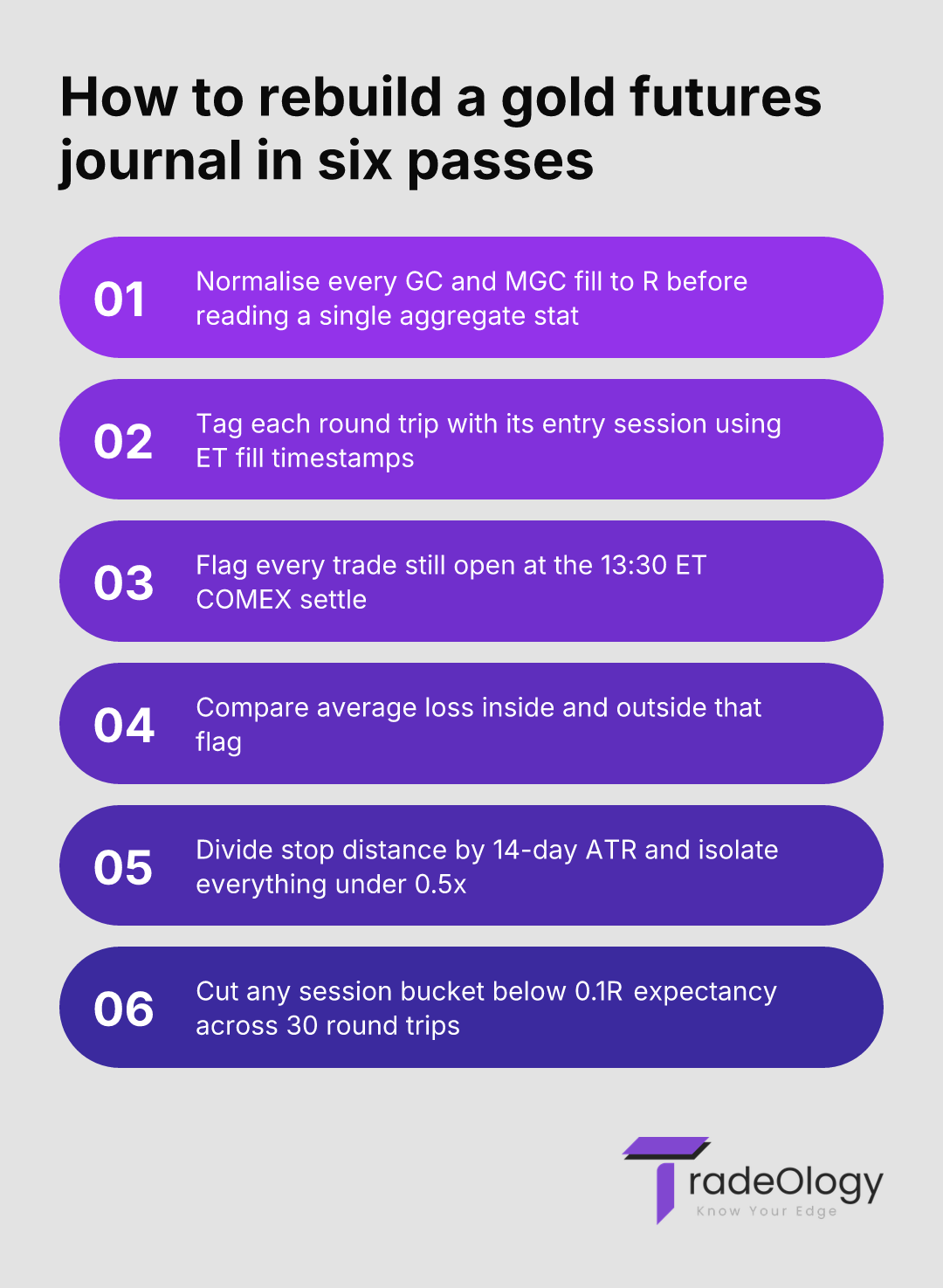
Normalise every GC and MGC fill to R before reading a single aggregate statistic.
Tag each round trip with its entry session using ET timestamps from the fill, not from your notes.
Flag every trade that was still open at 13:30 ET, then compare average loss across the flag.
Calculate stop distance divided by 14-day ATR and isolate everything below 0.5.
Eliminate any session bucket with expectancy below 0.1R across at least 30 round trips.
Six filters is usually enough to find the leak. The wider framework for running them honestly sits in this breakdown of review filters.
Reading the numbers your GC journal produces
Metric | What it actually means | Action to take |
|---|---|---|
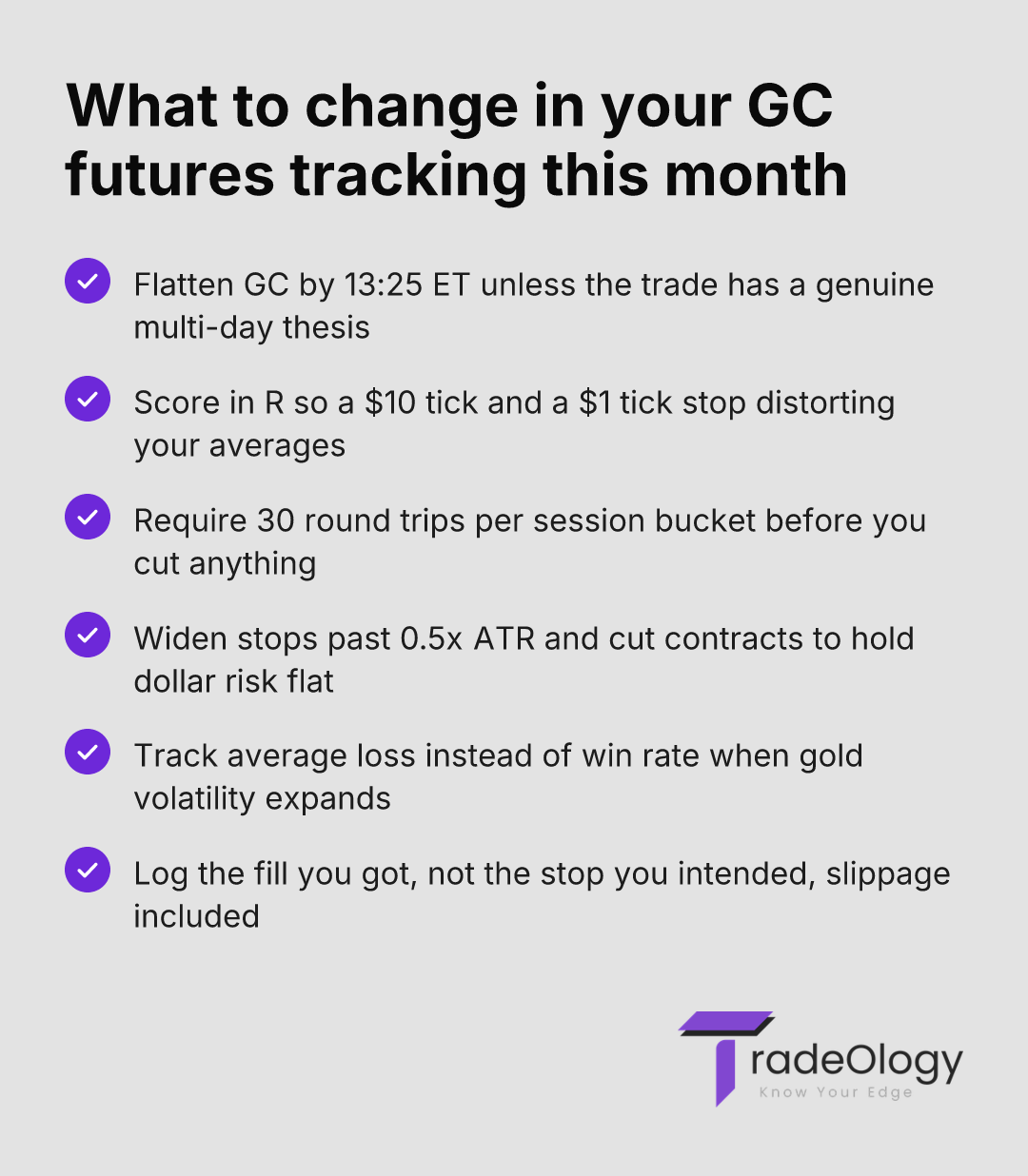
Average loss on settle-crossing trades > 1.3x intraday average loss | Your stops are being filled in a thin post-13:30 book. | Flatten by 13:25 ET unless the trade has a multi-day thesis. |
Win rate above 55% with profit factor under 1.2 | Losers are running past their stop level on fast tape. | Use resting bracket orders instead of mental stops. |
Dollar expectancy positive, R expectancy negative | MGC volume is inflating your win count while GC size does the damage. | Re-score the entire log in R and split the two contracts. |
Stop distance under 0.5x the 14-day ATR | You are paying for noise, not for a wrong thesis. | Widen the stop and cut contracts to keep dollar risk flat. |
MAE on winners above 0.8R | Entries are early and survive on luck rather than location. | Wait for the retest and log the skipped entries for comparison. |
A worked example: $50,000 account, one GC contract
A trader runs $50,000 and risks 1% per trade, so $500. On GC that is 50 ticks, or $5.00 per ounce. Over 62 round trips the log shows a 58% win rate, average win of 0.9R and average loss of 1.6R. Expectancy lands at -0.15R per trade. Negative, on a win rate most traders would defend.
Now split by the settle flag. The 41 trades closed before 13:30 ET produce +0.08R expectancy. The 21 trades carried past 13:30 produce an average loss of 2.3R and expectancy of -0.61R. Win rate across the two buckets differs by two points. The damage is entirely in loss size.
The second problem is structural. With a 14-day ATR around $60 per ounce, a 0.5x ATR stop is $30 per ounce, which on one GC contract is $3,000, or 6% of the account. Full-size GC does not fit a $50,000 account at that volatility. One MGC contract with the same $30 stop risks $300, or 0.6%. The trader was not choosing a stop. The contract size was choosing it for him.
If your gold futures win rate holds within three points while your average loss grows by a third, you do not have a setup problem. You have trades that outlived the liquidity that made them work.
Common mistakes in gold futures logging
Recording session by feel instead of by ET timestamp, which mislabels roughly one trade in five for anyone trading the London handoff.
Averaging GC and MGC into a single dollar expectancy, which hides a 10:1 weighting error.
Ignoring roll dates, so a February and April contract get compared as if the basis never moved.
Logging the stop you intended rather than the fill you received, which erases 4 to 8 ticks of slippage per trade from the record.
Treating a run of settle-crossing losses as variance instead of testing the flag against 30-plus trades.
Where TradeOlogy fits
TradeOlogy takes broker executions or a CSV and rebuilds them into round trips, which matters on GC because partial fills and scaled exits fragment a single position into four or five rows. Fragmented rows are how half a trader's round trips disappear on import. From there the platform breaks performance down by setup, by session and by hour, so the settle test above is a filter rather than a spreadsheet project.
Expectancy, profit factor, win rate and drawdown all recompute per bucket. Tag your GC and MGC trades separately and the 10:1 distortion resolves itself. Futures, stocks, options and crypto sit in the same log, so a metals trader who also runs equity swings is reading one equity curve instead of three. The trial is a card-on-file trial and you can cancel anytime.
FAQ
Why does my GC win rate hold up while my profit factor falls?
Profit factor is gross profit over gross loss, so it responds to loss size while win rate does not. On gold futures this pattern almost always traces to a handful of oversized losses in thin conditions. Sort your losses by R and look at the top five, then check what time each one closed.
Should MGC and GC trades sit in the same journal?
Same journal, separate tags, and every metric reported in R rather than dollars. The contracts share a chart but differ 10:1 in notional, so any dollar-based average blends two incompatible risk units. Once both are scored in R, a combined expectancy figure becomes valid.
How many gold futures trades do I need before session data means anything?
Thirty round trips per session bucket is the working minimum, and 50 is where the standard deviation of expectancy tightens enough to act on. Below 30, a single 3R outlier will move the bucket average by more than the effect you are testing. Keep collecting and re-run the filter monthly.
Does holding GC overnight change expectancy?
It changes the loss distribution more than the win rate. Overnight gold gaps on Asian-session macro headlines, and the gap ignores your stop level entirely. Tag overnight holds as a separate bucket and compare average loss, not hit rate.
The standard for your gold futures data
Every GC row in your journal needs five things: contract type, entry session in ET, stop distance as a multiple of ATR, an R-multiple, and a flag for whether the position survived the 13:30 settle. Anything less produces a log rather than a diagnostic, and the difference between the two is covered in this comparison. Add the five fields, then run the settle split before you touch your entry rules.
Verdict: Gold futures results are dominated by loss size, not hit rate, and the single field that separates the good losses from the ruinous ones is whether the trade was still open at the 13:30 ET COMEX settle. Tag it, score everything in R, and the setup you were about to abandon will probably turn out to be fine.