

Gold futures trading hours on CME Globex run from Sunday 5:00 p.m. Central Time to Friday 4:00 p.m. CT, with a 60-minute halt every afternoon between 4:00 p.m. and 5:00 p.m. CT. That is 23 hours of quotes and, for most retail accounts, about three hours of genuinely tradeable range. Traders rarely separate the two, because their hour-of-day report is denominated in dollars, and dollars already contain every sizing decision they made that day.
The gold session map most traders inherited is wrong
The Asia-London-New York framework came from spot commentary, and it does not map onto COMEX gold session times. Unlike a market with no official close, GC has hard structural markers: the legacy pit designation at 8:20 a.m. ET, the US data drop at 8:30 a.m. ET, the LBMA afternoon auction around 10:00 a.m. ET, settlement at 1:30 p.m. ET, and the Globex halt at 5:00 p.m. ET.
Tagging a trade "London" when the move that paid you came from an 8:30 a.m. CPI print destroys the analysis before it starts. You end up crediting a session that contributed liquidity and nothing else. Then you scale into that session next month and wonder why expectancy fell.
Check the CME contract specifications once and set your journal to the exchange clock, not your local one. Daylight saving shifts have quietly re-bucketed thousands of trades in journals that store local timestamps.
What matters inside gold futures trading hours is range, not volume
Volume tells you whether you can get filled. Range tells you whether your target is reachable. Those are different questions, and traders answer the first one and act as if they answered the second.
Here is the part that does not appear in any session-times table. GC delivers roughly twice the average hourly true range between 8:20 a.m. and 10:00 a.m. ET as it does between 1:30 p.m. and 4:00 p.m. ET. Almost nobody adjusts stop distance to match. A trader who uses a 5.0-point stop all day is asking a 4.5-point afternoon hour to produce a 10-point move for 2R. That trade is not losing because the setup failed. It is losing because the arithmetic was decided at the moment of entry.
The signature is specific and you can find it in twenty minutes. Pull your R-multiple distribution by hour. Morning trades cluster around a mix of -1R and +1.8R outcomes. Afternoon trades cluster at -1R and +0.4R, with a tail of scratches. Win rate collapses, average loss stays flat, and average win shrinks. That combination is a range-versus-stop mismatch, not a psychology problem. The same diagnostic logic applies to any 24-hour market, which is why the hour-by-hour breakdown in crypto produces the same shape of cliff.
How to rebuild your futures session performance table
Do this on at least 100 gold round trips. Fewer than that and you are reading variance.
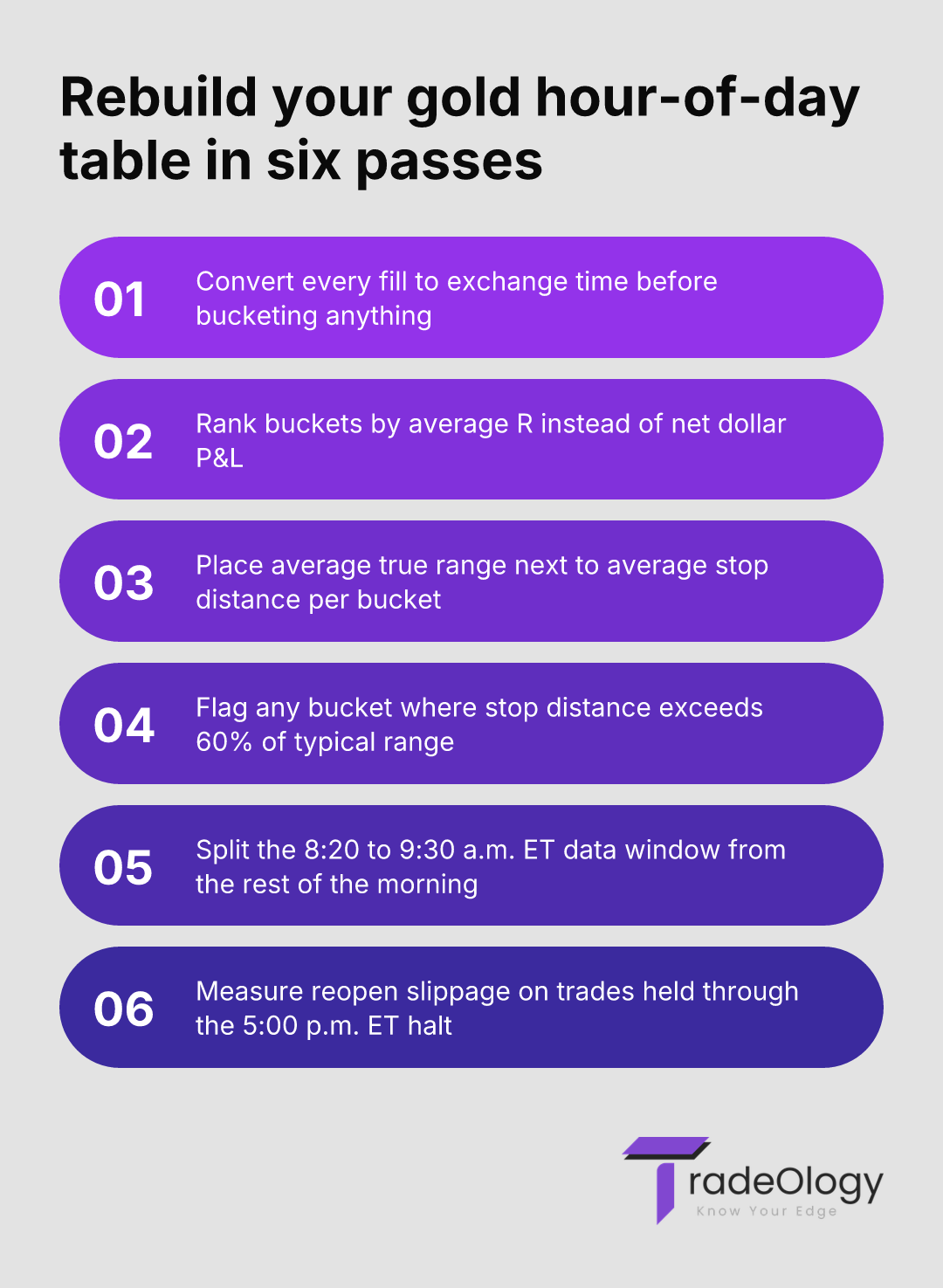
Normalise the clock. Convert every fill to exchange time. Re-bucket anything logged during a daylight saving transition.
Switch the y-axis from dollars to R. Dollar P&L per hour ranks your conviction. Average R per hour ranks your edge.
Add average hourly true range per bucket. Put your average stop distance next to it. Any hour where stop distance exceeds 60% of the hour's typical range is a structurally low-R hour.
Split the 8:20 to 9:30 a.m. ET block from the rest of the morning. Data-release trades and continuation trades are two different populations. Merged, they average into a lie.
Flag every trade held through the 5:00 p.m. ET halt. Measure the reopen gap against your stop distance, not against your entry.
Setup Checklist:
Filter gold round trips into 90-minute buckets from 6:00 p.m. ET and rank by average R, not net dollars.
Calculate average stop distance per bucket and compare it to that bucket's average true range.
Tag data-release entries separately from technical continuation entries in the 8:20 to 9:30 a.m. ET window.
Eliminate any bucket with 25-plus trades and expectancy below -0.10R for one full month.
Review reopen slippage on every position carried through the daily 60-minute halt.
Reading the numbers your hour-of-day analysis produces
Metric | What it actually means | Action to take |
|---|---|---|
Best hour by dollars is not best hour by average R | You size up on conviction, not on measured expectancy. | Flatten size across buckets for 30 trades and re-rank. |
Stop distance above 60% of the hour's average true range | Your 2R target needs more range than the hour usually gives. | Cut stop distance or stop trading that bucket. |
Win rate under 35% after 1:30 p.m. ET with flat average loss | Range compression, not setup failure or tilt. | Trade MGC at reduced size or close the session out. |
Profit factor above 1.5 in one bucket, under 0.9 in the next | You are funding a losing session with a winning one. | Ring-fence the losing bucket and remove it entirely. |
Reopen gap after the 5:00 p.m. ET halt exceeding 1R | Carried positions are exposed to unhedgeable gap risk. | Size held positions for the gap, not for the stop. |
A $50,000 account, 120 gold trades, one broken session
A trader running a $50,000 futures account risks 1% per trade, so $500. One GC contract with a 5.0-point stop is exactly $500 of risk at $100 per point. Six months of data, 120 round trips.
Morning block, 8:20 a.m. to 11:00 a.m. ET: 74 trades, 47% win rate, average win 1.9R, average loss -1.0R. Expectancy is +0.363R per trade, or +26.9R across the block. In dollars, +$13,450.
Afternoon block, after 1:30 p.m. ET: 46 trades, 31% win rate, average win 1.6R, average loss -1.0R. Expectancy is -0.194R, or -8.9R. In dollars, -$4,462.
Net result: +$8,988 instead of +$13,450. The afternoon gave back 33% of the morning's gains without ever registering as a losing streak. And the reason was not discretion. Average stop distance in both blocks was 5.0 points. Average hourly true range was 9.1 points in the morning and 4.4 points in the afternoon. The afternoon setup could not physically reach 2R inside its normal holding window.
One more detail from the same dataset. The single highest dollar hour was 8:30 to 9:30 a.m. ET, where the trader ran two contracts on data releases. Average R in that hour was 0.21. The best hour by average R was 3:00 to 4:00 a.m. ET at 0.44R, traded on a single contract, and it produced less than half the dollars. That gap is not information about gold. It is information about the trader.
If your best hour by dollars is not also your best hour by average R, you do not have a session edge — you have a sizing habit, and the market invoices you for the difference every month.
Mistakes that survive because nobody buckets the data
Treating 23 hours of quotes as 23 hours of opportunity. Liquidity between 8:00 p.m. and 1:00 a.m. ET is thin enough that a 5-point stop absorbs slippage the backtest never priced.
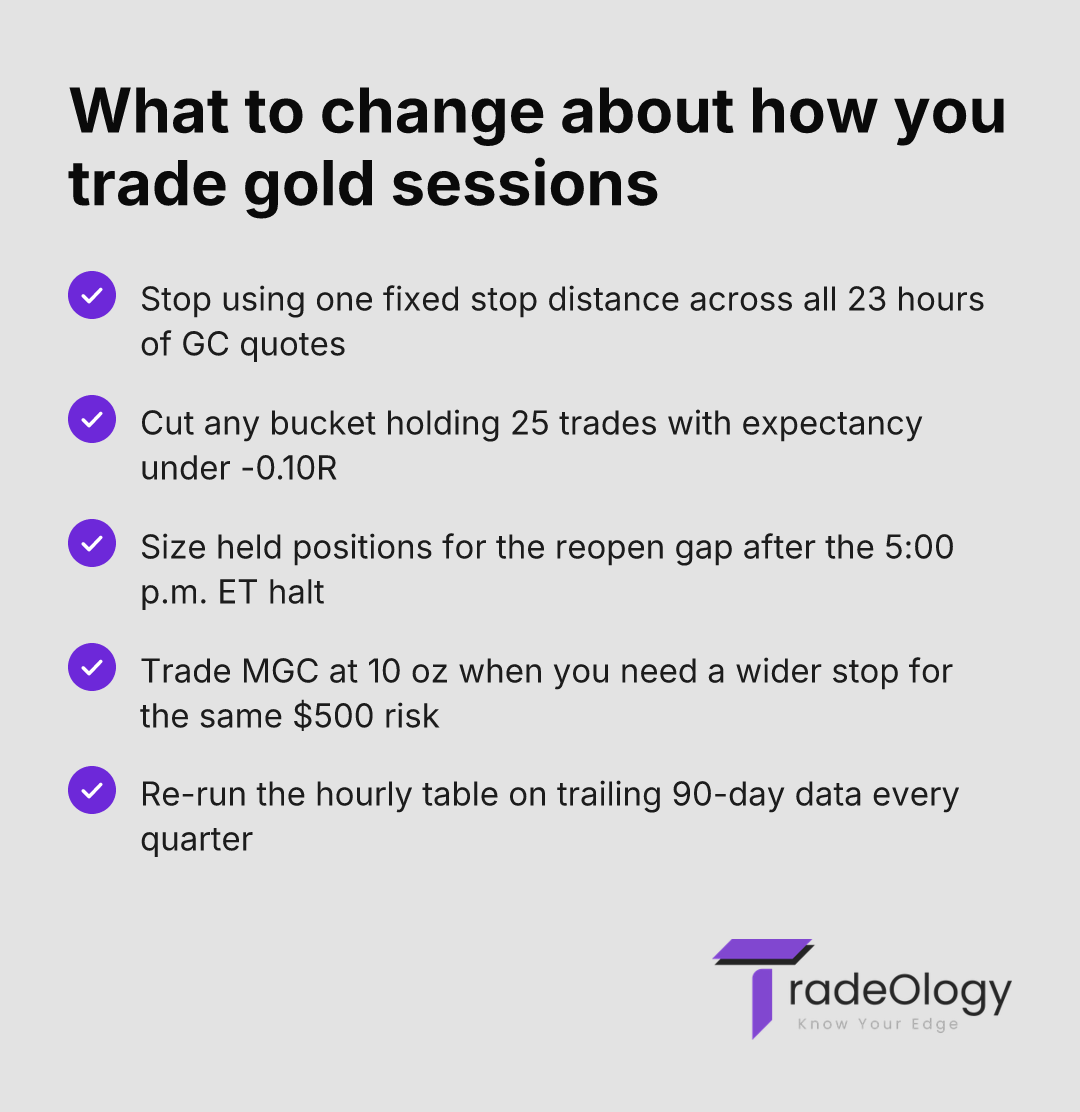
Using one stop distance across all gold futures trading hours. A fixed stop against a variable range is a variable R:R pretending to be a fixed one.
Holding through the 5:00 p.m. ET halt without gap sizing. Your stop does not work during the break. Position size is the only control you have, a point covered in more depth in the sizing comparison between swing and day trading.
Judging a session on win rate. A 55% bucket with 0.8R average wins is worse than a 38% bucket with 2.4R average wins. Rank by expectancy, not hit rate.
Running 2023 assumptions in 2026. Gold's volatility regime has shifted more than once since then. Re-run the hourly table on trailing 90-day data every quarter.
Where TradeOlogy does the bucketing for you
Hand-building a session table in a spreadsheet works once and then rots, mostly because timestamps and partial fills fight you. Connect the broker account or import a CSV, and TradeOlogy stitches executions into round trips with fill-level timestamps intact — the same problem covered in the broker-versus-CSV fill-level test.
From there the performance-by-hour and performance-by-session views give you the R-ranked table this article asks for, alongside expectancy, profit factor and drawdown per bucket. Tag data-release entries as their own setup and the platform will separate them from continuation trades automatically, the same way it separates setups that actually pay from setups that only feel productive. Stocks, options, futures and crypto sit in one log, so a gold trader who also runs equities can compare hour-of-day behaviour across both. Cancel anytime.
FAQ
Why does my gold expectancy collapse after 1:30 p.m. ET?
Settlement at 1:30 p.m. ET pulls institutional flow out of the book, and average hourly true range in GC roughly halves for the rest of the afternoon. If your stop distance stays constant, your effective reward-to-risk halves with it. Look for a win-rate drop with a flat average loss — that pattern is range compression, not a failing setup.
Should I hold GC positions through the 5:00 p.m. ET Globex halt?
Only if the position is sized for the reopen gap rather than for the stop. Stops do not execute during the 60-minute break, so a 1.5R gap against you is entirely possible on a headline. Measure your own historical reopen slippage before deciding — most traders find it exceeds their assumed worst case.
How many trades do I need before hour-of-day analysis is trustworthy?
Roughly 25 round trips per bucket, and ideally 100 or more in total. Below that, one 3R outlier can reorder the entire ranking. If your sample is thin, group into 90-minute or three-hour blocks rather than single hours.
Do COMEX gold session times differ from the London gold market?
Yes. COMEX gold futures follow the CME Globex schedule with a daily halt, while the London over-the-counter market runs on its own liquidity cycle and prices the LBMA auctions at 10:30 a.m. and 3:00 p.m. London time. The afternoon auction lands near 10:00 a.m. ET and reliably shows up as a range spike in GC.
Does trading MGC instead of GC change my hour-of-day results?
The range profile is identical, but micro gold at 10 troy ounces lets you keep the same dollar risk with a wider stop. That is the practical fix for low-range afternoon hours: same $500 risk, stop sized to the hour instead of to the contract.
Verdict
Gold futures trading hours are not a schedule problem, they are a sizing problem wearing a schedule's clothes. Rank your buckets by average R rather than dollars, match stop distance to each bucket's average true range, and delete any hour that stays below -0.10R expectancy over 25 trades. The hours you keep will pay you more than the hours you added.